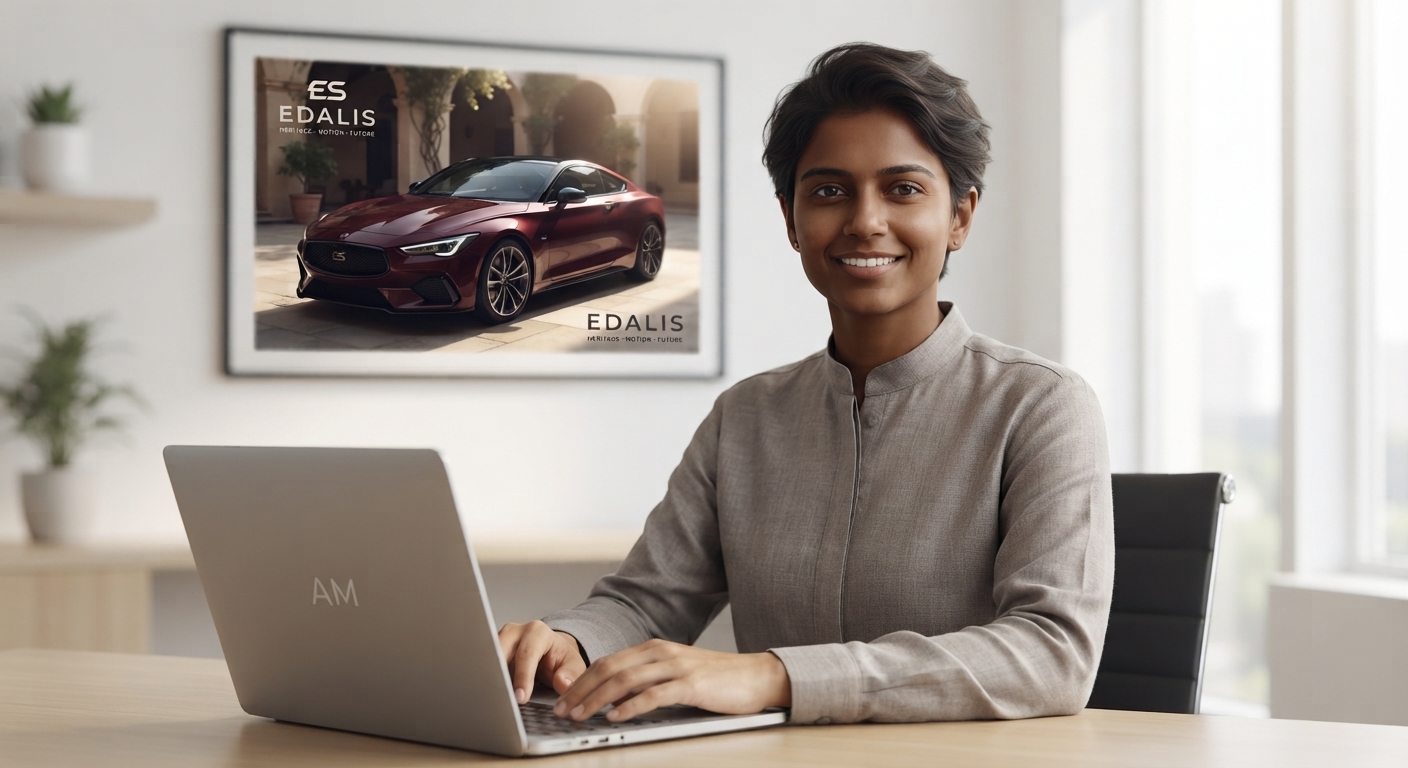
Shree Talukar spent her childhood polishing a dead man’s car. Now she’s built a company on the theory that the future of the automobile was, in some sense, already designed nearly a century ago — it just needed a battery.
There is a particular kind of quiet that settles over a garage at seven in the morning, before the rest of the house has woken and before the Bangalore heat has properly asserted itself. It was in exactly this quiet, some three decades ago, that a nine-year-old Shree Talukar would let herself in through the side door, climb onto an upturned crate, and begin — with more enthusiasm than technique — to polish the bonnet of a car that was, by any sensible measure, none of her business.
The car had belonged to her grandfather. A sweeping, long-nosed thing from the 1930s, its fenders curved like something poured rather than pressed, its chrome gone slightly soft with age but never, under her grandfather’s watch, allowed to dull. He had bought it decades before anyone thought old cars were worth keeping, restored it twice, and treated its maintenance as something between a hobby and a devotional practice. When he died, the car passed — somewhat to the surprise of older, more obviously car-mad cousins — to Shree.
“I don’t think anyone in my family quite understood why he left it to me,” she says now, sitting in EDALIS’s Bangalore studio, a space that smells faintly of clay modelling compound and fresh upholstery leather. “I was nine. I couldn’t drive it. I could barely see over the dashboard. But he used to let me sit in the driver’s seat while he worked underneath, and I think he’d decided, quietly, that I was the one who was actually looking at it. Not just riding in it. Looking at it.”
It is a distinction she returns to often, and one that has become, whether she intends it or not, something close to a personal manifesto.

An Engineer Who Kept Getting Distracted by Beauty
Talukar’s formal education followed a fairly conventional Bangalore trajectory for someone of her generation: a mechanical engineering degree, followed by a postgraduate diploma in industrial design, both completed without ever leaving the city that raised her. It was, she admits, a slightly stubborn choice. “People kept asking why I wasn’t going abroad. Milan, London, wherever design people were supposed to go to become serious. And I understood the appeal. But I had this feeling — probably an unreasonable one — that if I left, I’d come back trying to design European cars with an Indian accent, instead of the other way round.”
Her early career was spent in component design for two of India’s larger automotive suppliers, work she describes with the particular fondness people reserve for jobs that taught them what they didn’t want to do. “I was very good at making a wing mirror housing that met every regulatory requirement and inspired absolutely no feeling whatsoever in anybody. I got promoted for it, which tells you something about the industry at the time.”
The turning point, as she tells it, arrived on an unremarkable Tuesday, when a colleague — one of the aforementioned cousins, in fact — asked to borrow the old car for a wedding. Talukar spent the morning going over it, the way she still did periodically, and found herself, notebook in hand, sketching the line of the front fender purely because she wanted to understand why it worked. Why a shape drawn in an era with no wind-tunnel data, no computational modelling, nothing but a designer’s eye and a great deal of confidence, still looked more alive than most of what she’d been paid to draw that year.
“I sat in my grandfather’s garage for four hours that day, not because I needed to, but because I’d forgotten that cars were allowed to be beautiful and not just efficient. That was the moment I decided to stop making wing mirrors.”
Building EDALIS
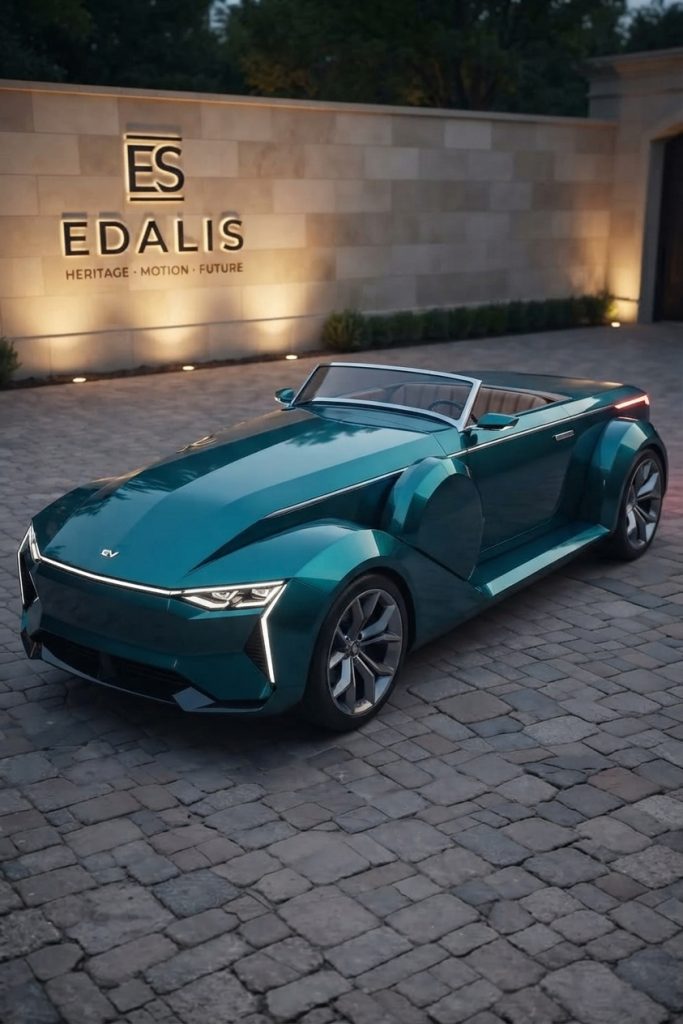 EDALIS — the name a compression of ideas Talukar is still faintly embarrassed to explain in full, though she eventually does, involving Sanskrit roots for motion and a stubborn insistence on it sounding good in three languages — was founded not with a grand unveiling but with a much smaller, much odder proof of concept: a single clay model, built at half scale, of what her grandfather’s car might look like if it had never stopped evolving.
“It wasn’t a retro pastiche. I hate pastiche. I wanted something that felt like an unbroken lineage — as if the 1930s design language had simply kept developing for ninety years instead of being interrupted by chrome bumpers and then aerodynamics and then, frankly, a lot of very boring crossovers.”
The model made the rounds of exactly the kind of small, invitation-only design showcases that either go nowhere or become the founding myth of a company. In this case, it was the latter. A group of early investors — none of whom, Talukar is quick to point out, had any particular nostalgia for vintage cars — were struck less by the styling than by what it implied about restraint. “Old cars had presence because designers weren’t yet drowning in things they were allowed to add. My argument was: give me that restraint back, but let me use it on a modern EV platform, where I don’t have a combustion engine dictating half my proportions anyway.”
EDALIS’s now-familiar tagline — Heritage · Motion · Future — emerged, appropriately, from an argument. Talukar wanted something that acknowledged the debt to the past without becoming a company built entirely on nostalgia. “Heritage on its own is a museum. Future on its own is a slogan. You need the motion in the middle, or it’s just two nice words facing each other and doing nothing.”
The Design Philosophy, in Practice
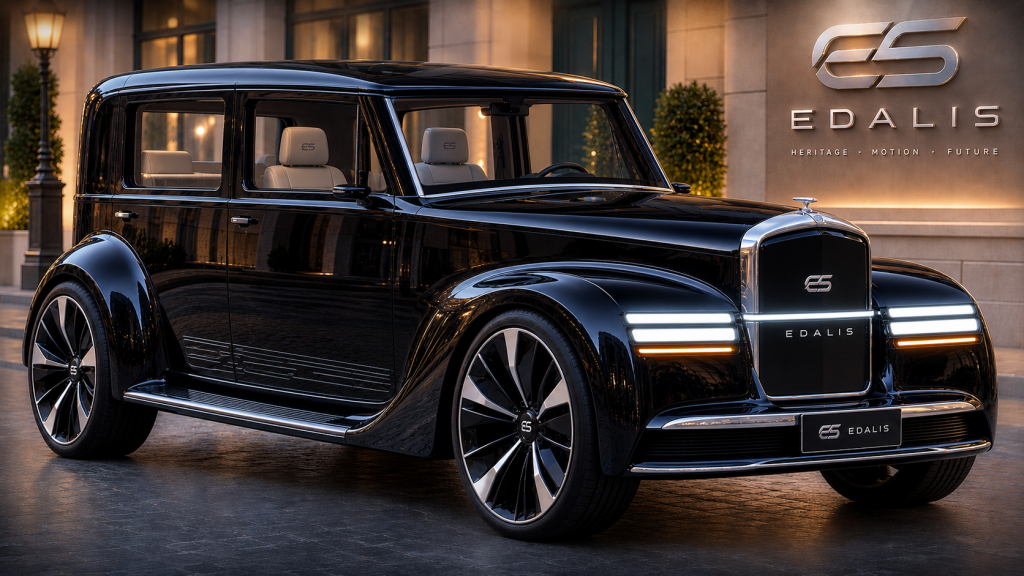 Walk through an EDALIS design review — Talukar permitted a brief one, on the condition that specifics of unreleased models stayed off the record — and the vocabulary is unlike most modern car studios. There is a great deal of talk about “silhouette integrity,” about which vintage proportions are sacred and which are merely sentimental, and a running debate, apparently constant, about how much of a car’s original character survives the moment you remove a grille that no longer needs to cool an engine.
“That’s the single hardest problem in everything we do,” Talukar says. “A 1930s car’s face is built around a grille, because it had to breathe. An EV (Electric Vehicle) doesn’t need to breathe in the same way, so you lose the visual anchor the whole front end was designed around. My team will spend three weeks on a headlight signature just trying to give the car something to organise itself around that isn’t a grille. It’s like redesigning a face after removing the nose.”
She is, by her own admission, a difficult person to please in these reviews, prone to sending designers back to their screens over details most people would never consciously notice — a wheel arch that reads as fractionally too generic, a character line that “explains itself too quickly.” A former colleague, granted anonymity to speak candidly, describes her as “the kind of boss who will look at forty hours of work and ask why it doesn’t feel like anyone’s grandfather owned it yet.”
Talukar laughs when this is repeated to her, but doesn’t dispute it. “I probably do say something like that. I want every car we make to feel like it has a story attached, even if the story is invented. Ours has just never had to be invented, because I’ve had it sitting in a garage since I was nine.”
What Comes Next
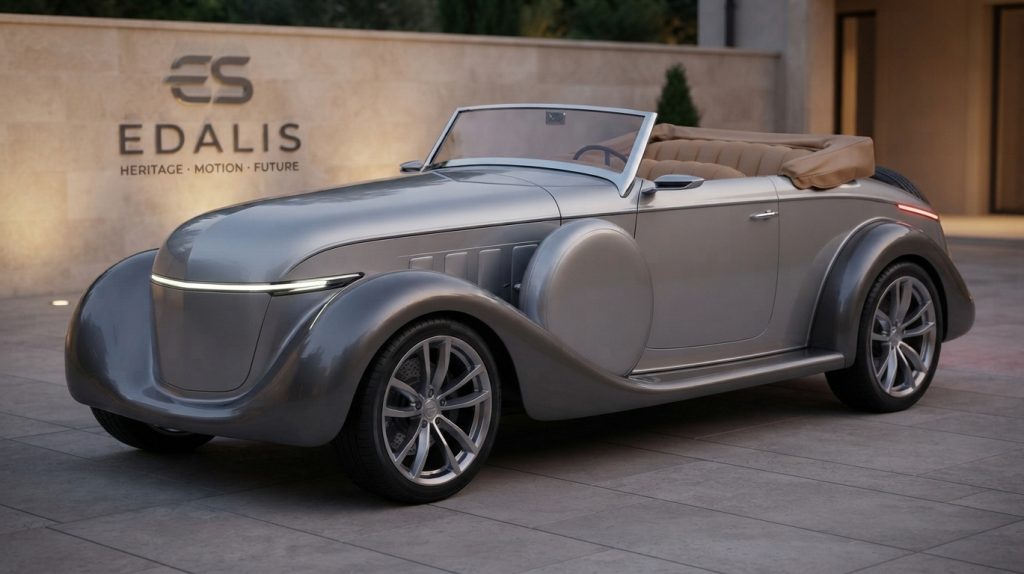 EDALIS remains, by the standards of the global EV industry, a small operation — modest production volumes, a design-led rather than volume-led strategy, and a customer base that Talukar cheerfully describes as “people who would rather own one car they think about than three cars they don’t.” Whether that approach scales into something larger is, she concedes, the open question hanging over the company’s next decade.
What she is considerably more certain about is the underlying premise. “People assume heritage design is about looking backward. I don’t think it is. I think it’s about noticing that somebody, ninety years ago, solved a proportion problem so well that we’re still admiring it, and asking what they’d have done next if nobody had ever told them to stop.”
Her grandfather’s car, incidentally, still runs. It lives in the same garage, now considerably tidier than it was in her childhood, and she still polishes it herself, on the same quiet mornings, before the rest of the studio arrives. “It’s not sentimental,” she insists, in the tone of someone who knows perfectly well that it is. “I just think a designer should have to look, every so often, at the thing that started all this, and ask honestly whether they’ve earned the right to keep changing it.”