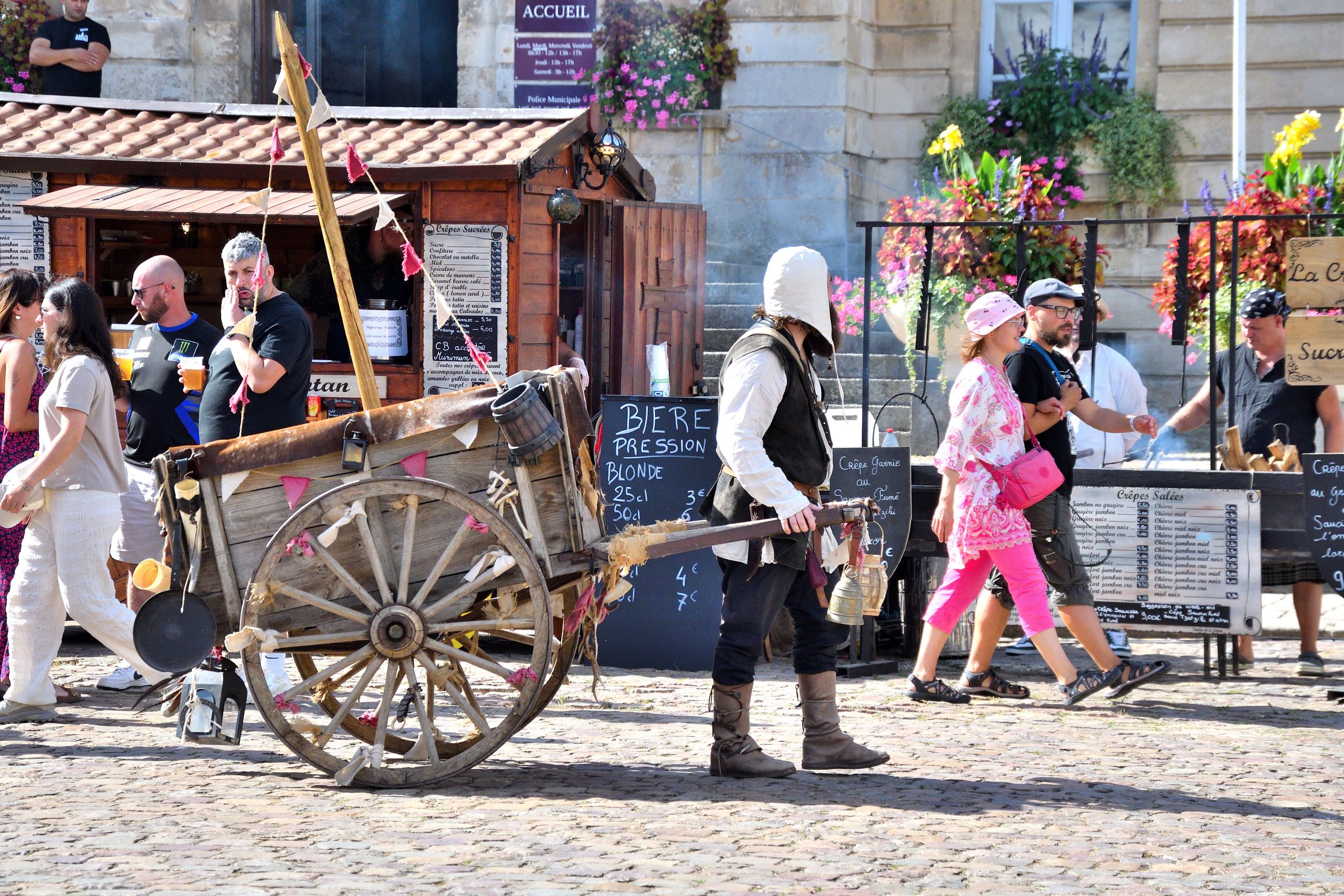
Some towns commemorate history from a respectful distance. Falaise, in the Calvados department of Normandy, does something bolder: for one weekend each August, it turns itself inside out and lets the Middle Ages walk its streets. On 8 and 9 August 2026, Les Médiévales de Falaise marks its twenty-fourth edition, transforming the bailey of the Château Guillaume-le-Conquérant and the town centre beyond it into a sprawling, deliberately chaotic tableau of Norman, Viking, and Levantine medieval worlds — jousting knights beside Viking axe-throwers, Crusader-era encampments beside street theatre troupes of reformed bandits turned musicians. It is a peculiar kind of history lesson, equal parts scholarship and carnival, and it is staged in perhaps the one place in France with the strongest possible claim to hosting it: the fortress where William the Conqueror was born.
A Fortress with a Founding Myth
To understand why Falaise carries this particular weight, it helps to go back to the castle itself, and to the story — part history, part legend — that clings to its walls. Around 1028, Robert I, Duke of Normandy, is said to have glimpsed a young tanner’s daughter named Herleva washing linen in the stream below the fortress and taken her as his mistress. Their son, born at Falaise, was William — known in his own lifetime, without much delicacy, as William the Bastard, and known to posterity, after 1066, as William the Conqueror. His illegitimacy was not a minor biographical detail; in the fiercely status-conscious world of eleventh-century Norman aristocracy, it was a standing vulnerability that rival barons never let him forget, and that shaped the ruthless political education he received as a boy duke fighting to keep his own nobles from swallowing his inheritance whole. By the time he crossed the Channel in 1066 to claim the English crown at Hastings, William had already spent two decades turning a precarious, contested duchy into one of the most disciplined military and administrative machines in Europe — a talent for consolidation he then exported wholesale to England, reshaping its landholding, its aristocracy, and eventually, through the Domesday survey of 1086, its very administrative memory. That the man who built the Anglo-Norman state should have been born in a fortress in the Pays d’Auge is not merely a charming local claim; it is one of the more consequential accidents of medieval European history, and it gives Falaise a legitimate claim to be staging something rather more pointed than generic medieval cosplay.
Rebuilding a Duchy: The World the Festival Reaches For
The various encampments and performances scattered through the 2026 programme do not confine themselves to William’s own eleventh century, ranging instead across the twelfth and thirteenth centuries and, further afield, into the Crusader-era Levant — but the underlying preoccupations of the age remain recognisably continuous. Norman society in this period was one still working out the practical consequences of its own success: a duchy that had exported conquerors to England, to southern Italy, and to Sicily needed an increasingly sophisticated apparatus of law, land tenure, and record-keeping to hold its gains together, and the encampment of the Aisling-1198 association, reconstructing a twelfth-century Norman camp with calligraphy, period cookery, and blacksmithing demonstrations, gestures towards precisely this — a society that prized documentation and craft alongside martial prowess.
Further into the festival grounds, the presence of the Guerriers d’Ibelin, Al Qafilah, and Dovahkiin encampments, exploring Crusader-era military culture, Turcopole equipment, and the medicine, games, and material culture of Baghdad and Al-Andalus, points to a genuinely important and often under-told dimension of medieval Norman history: contact, however violent or uneven, with the Islamic world. Norman knights fought in the Crusades and settled in Sicily and Antioch; the resulting exchange of medicine, science, cuisine, and luxury goods flowed in both directions and left its mark on European material culture for centuries. A festival willing to stage Levantine and Andalusian medieval life alongside a Norman ducal encampment is, whether consciously or not, making an argument about the period that more parochial reenactments tend to flatten: that medieval Christendom was never hermetically sealed, and that its wealth of ideas often arrived from precisely the directions its wars were fought in.
Elsewhere, the festival reaches north rather than south. The Clan d’Ivar’s itinerant Scandinavian camp and the Valhalla axe-throwing tavern nod to the Viking heritage that gave Normandy its very name — Northmen who settled the Seine valley in the tenth century, converted to Christianity, and within a few generations had become the most aggressively expansionist power in Western Europe, exporting their descendants as far as England, Sicily, and the Holy Land. The presence of Viking-themed activity at a festival centred on William’s castle is not an anachronistic add-on so much as a reminder of where Norman identity actually came from: not from timeless French rootedness, but from a relatively recent and remarkably successful act of cultural assimilation.
 Fools, Bandits, and the Business of Laughter
Not every corner of the Médiévales concerns itself with dukes and armies, and this is arguably where the festival becomes most interesting for anyone curious about the social textures of medieval life rather than its political summits. Among the festival’s headline acts is Les Maroufles, a street theatre production by the Rennes-based Compagnie Sonjévéyés, a troupe of ten performers — actors, jugglers, acrobats, dancers, stilt-walkers, and musicians — who have toured France for close to two decades with a repertoire built around burlesque, circus, and pyrotechnic performance. Their medieval-themed piece imagines a family of grotesque, disreputable travelling entertainers, self-styled “affreux, bêtes et méchants” — the awful, the beastly, and the wicked — leading audiences through a farcical, faintly menacing fairground of freaks and fools, complete with juggling, whip-cracking, nail-board stunts, and audience participation that regularly drags the youngest spectators into the act. It is broad, deliberately vulgar entertainment, and that is exactly the point: medieval fairs and market days were genuinely full of precisely this kind of itinerant performer, operating in the tolerated margins of respectable society, selling laughter, minor spectacle, and a controlled dose of transgression to audiences who had few other outlets for either. The court of miracles that Les Maroufles conjures — beggars, charlatans, and confidence tricksters occupying their own semi-organised underworld — was a genuine feature of late medieval urban life, satirised and moralised over by contemporary preachers precisely because it was so visibly, persistently there. A festival that stages both a duke’s fortress and a troupe of fairground grotesques in the same weekend is, in its own unpretentious way, giving a reasonably accurate cross-section of medieval society’s vertical range, from the castle keep to the market square gutter.
That same instinct for the disreputable runs through several of the festival’s other performances: Les Coupeurs de Bourses imagines a quartet of highway robbers who have reinvented themselves as musicians, while Théâtre de Pan’s “Brigand Emploi” comically restages banditry as a profession bogged down in the same tedious bureaucracy as any other trade — a gentle joke that nonetheless points to something real, since organised brigandage, extortion, and the private violence of disbanded soldiery were persistent and genuinely disruptive features of medieval rural life, particularly in the war-scarred decades of the fourteenth and fifteenth centuries.
A Fortress Still Doing Its Job
None of this would carry quite the same charge without its setting. The Château Guillaume-le-Conquérant is not a folly built for atmosphere; its earliest stone keep dates to the late eleventh and early twelfth centuries, raised on a rocky spur above the Ante valley, and it went on to play a serious strategic role for centuries afterwards — besieged, refortified, and fought over well beyond William’s own lifetime, including during the very Hundred Years’ War that reshaped so much of the Normandy this publication has covered before. That the town’s great annual festival should unfold in its bailey and spill out into the surrounding streets — culminating, on the Saturday evening, in a costumed parade through the town centre bringing together performers, volunteers, and members of the public in equal measure — gives the event a continuity that purely invented “medieval villages” elsewhere cannot claim. This is not a stage set imported for the weekend; it is the genuine article, still standing, still doing more or less what it was built to do: gather people at the base of Norman power and make them pay attention.
Getting There
Les Médiévales de Falaise runs on Saturday 8 and Sunday 9 August 2026, centred on the Château Guillaume-le-Conquérant and the historic centre of Falaise, roughly forty kilometres south of Caen. The Saturday evening parade through the town centre is free to attend, as is the festival’s market, now grown to more than a hundred exhibitors; ticketed access applies to certain zones and performances within the château grounds, with further detail, the full programme, and online booking available via the festival’s own website.
For a photographic sense of what the weekend actually looks like on the ground, the Normandy-based photographer René Cortin, of Lisieux, has documented the festival in an album worth spending time with: flic.kr/s/aHBqjD1ZF4.