
There is something disarming about René de Gripon in person. He arrives at our meeting — a quiet corner of a hotel lobby bar, somewhere between a business trip and a disappearing act — in a linen jacket and unhurried manner that suggests a man who has learned not to rush his own thinking. He orders still water. He takes a moment before answering almost every question, not out of evasion, but out of what I can only describe as respect for precision. He wants to say exactly what he means.
I had already spent two hours with his pitch materials for The Gallery before sitting down with him, and I’ll confess: I walked into this interview already converted. The concept — a corrupt Australian prison warden secretly staging brutal handball matches between inmates strapped into adult-sized baby walkers, performed for an audience of ultra-wealthy spectators watching from an upper gallery — is one of those ideas that sounds, on paper, completely deranged. And then you sit with it for ten minutes, and you realise it is also completely inevitable. It says something true. It just takes a while to work out exactly what.
De Gripon, for his part, seems quietly amused that the world is only now catching up.
AAL: I have to start at the beginning, because the origin story here is genuinely strange. The Gallery grew out of a product concept — the Walkin’ Mate. You invented an adult baby walker before you invented a TV series. How does that happen?
RDG: It starts with an observation, really. I was thinking about the way authority figures treat people they consider beneath them — the infantilisation of it. The way a boss speaks to an employee they don’t respect. The way a state speaks to a citizen it has already decided to discard. There’s a particular gesture of contempt that consists of not even bothering to be cruel in an adult way. You demean someone by treating them like a child. And I thought: what if you made that literal? What if the humiliation was physical, engineered, designed? That was the Walkin’ Mate. The object came first. The story followed the object.
AAL: And the game — handball inside adult baby walkers, no referee, in a prison — when did that arrive?
RDG: The game arrived when I asked myself: who would build these things? And more importantly, who would make other people use them? That question has a very specific answer. It is not a good person. (He smiles.) So I had a villain before I had a story. I built the story around what kind of man commissions such an object and what he intends to do with it.
AAL: Which brings us to Warden Paul. He is the centre of everything, and yet he is — and I say this with enormous affection for the character — a genuinely monstrous human being. What drew you to him?
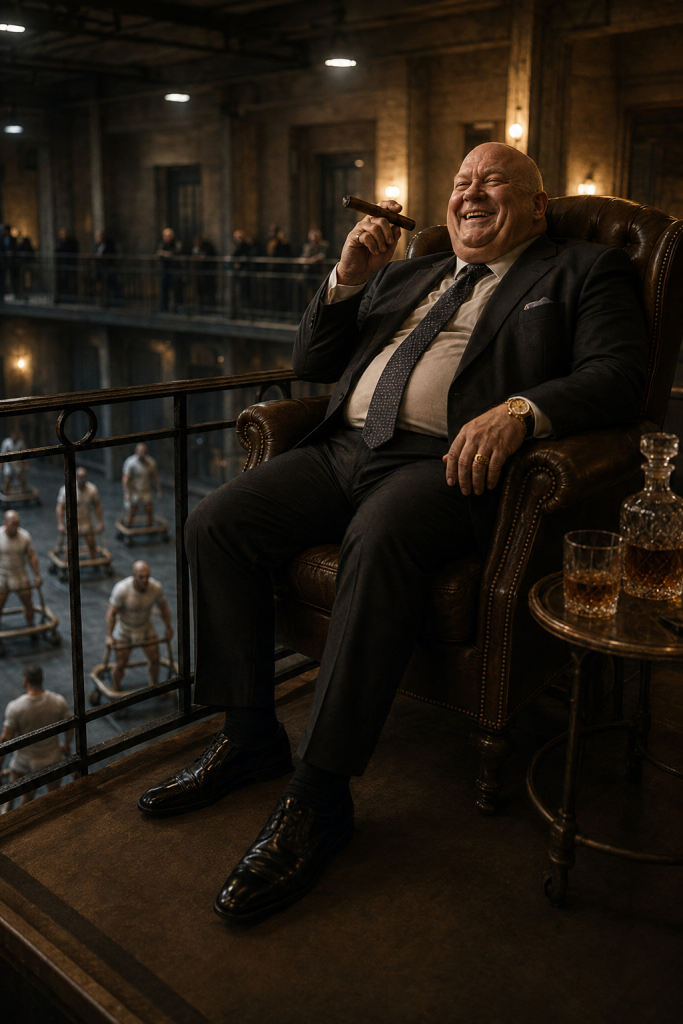 RDG: What drew me to him is that he doesn’t think so. Nobody sees themselves as the villain. Warden Paul believes he has found an elegant solution. He has inmates who are going to be difficult regardless — men with enormous physical energy and nowhere to put it, in a system that has no interest in rehabilitating them. He has created a spectacle. He has created, in his mind, a kind of order. He even believes the guests who attend are simply enjoying something rare and honest — something the sanitised world outside doesn’t allow. He is completely wrong, of course. But his wrongness is coherent. That’s what makes him interesting to write.
AAL: He’s also — and the concept art makes this very clear — almost Falstaffian. Big, bald, laughing in his armchair with a cigar. There’s something almost theatrical about him.
RDG: Deliberately so. He is performing. Every villain of that type is performing. The suit, the watch, the ring — these are costume elements. He has constructed a persona that says: I am a man of taste, of authority, of hospitality. He welcomes his guests with drinks and food as though they are at a grand prix. The theatre of it is essential to him. Strip away the performance and there is something much darker underneath. That’s what the series intends to show, slowly.
AAL: Let’s talk about Estelle-Fanny. She is extraordinary — this elegant, razor-sharp Frenchwoman who calls herself “The Project Manager.” Why French? Why her?
RDG: Because competence of that order tends to be invisible when it lives in a woman, and I wanted to write a character whose competence is the most dangerous thing in the room. Estelle-Fanny is the one who makes all of it function. She selects the guests, she manages the formats, she controls the schedules. Warden Paul has the vision and the appetite. She has the architecture. A French sensibility felt right for a character who maintains perfect composure in impossible circumstances — there is a certain cultural tradition of elegant detachment that I find fascinating and, in this context, slightly terrifying.
AAL: And then there’s Chief Beck, who may be my favourite character in the entire pitch, purely because he never speaks.
RDG: (laughing softly) Chief Beck is the most interesting writing exercise I’ve given myself in years. The constraint — he only whispers, occasionally, in Warden Paul’s ear — forces you to convey everything through posture, through placement, through what other characters do in his presence. The inmates know him only as Chief Beck. That’s all. They don’t know his rank, his history, nothing. And yet they modify their behaviour the moment he enters a room. That is a particular kind of power. I wanted to study it.
AAL: The inmates themselves — Goran, Wu Kang Ye, Wilburn — each of them has a backstory that is, on reflection, morally complicated. These are violent men, but their violence had a logic to it.
RDG: That was essential. I didn’t want to populate Millicrane Heights with monsters or victims. These men made choices that the world decided were criminal, and some of those choices — I’ll let the audience decide — were perhaps the only choices available to them. Goran put a man in hospital who had been putting his sister in hospital. Wilburn destroyed someone who had destroyed his younger brother. There’s a symmetry to their violence that the law doesn’t recognise. That gap between what is legal and what is just — that’s the thematic engine of the whole series.
AAL: The game itself — the mechanics are surprisingly elegant for something so brutal. The rule about not moving while holding the ball creates this strange, suspended quality. Was that intentional?
RDG: Very much. I wanted moments of stillness inside chaos. You catch the ball, and suddenly you are completely exposed, completely static, the walker around you, the crowd watching from above. You have to think. You have to choose. And then the moment passes and everything is violent again. It felt like a metaphor for something, though I’m not sure I want to name it too precisely.
AAL: The wealthy guests watching from the gallery — who are they?
RDG: They are us, in a way, aren’t they? People who have enough money to be insulated from consequences. People who consume suffering at a safe distance and call it entertainment. I didn’t want to make them cartoons. Some of them are uncomfortable with what they’re watching. Some of them are not uncomfortable enough. All of them keep coming back.
AAL: You’ve cited Squid Game and Wentworth as tonal reference points — two very different shows. What does The Gallery do that neither of them does?
RDG: Squid Game is an allegory that announces itself as an allegory. Wentworth is psychological realism inside a genre framework. The Gallery sits somewhere between the two, but what I think it does differently is refuse to explain itself morally. I don’t want the audience to know how to feel. I want them to be entertained and then disturbed by the fact that they were entertained. That’s the real game.
AAL: Six episodes. Is there resolution?
RDG: (a long pause, a small smile) There is an ending.
AAL: That’s all I’m getting, isn’t it?RDG: That’s everything.
Walking out of the lobby bar an hour later, I find myself thinking about the Walkin’ Mates — those crude, handmade wooden and metal contraptions with their mismatched wheels — and what it means that someone sat down one day and thought: what if an adult had to use one of these? The question is absurd. The question is also, somehow, the right question. René de Gripon has built something strange and serious and genuinely hard to look away from. The Gallery is not yet a television series. But it feels, already, like one of those ideas that was always going to exist. Someone just had to be the one to build it first.The Gallery is currently in development.*