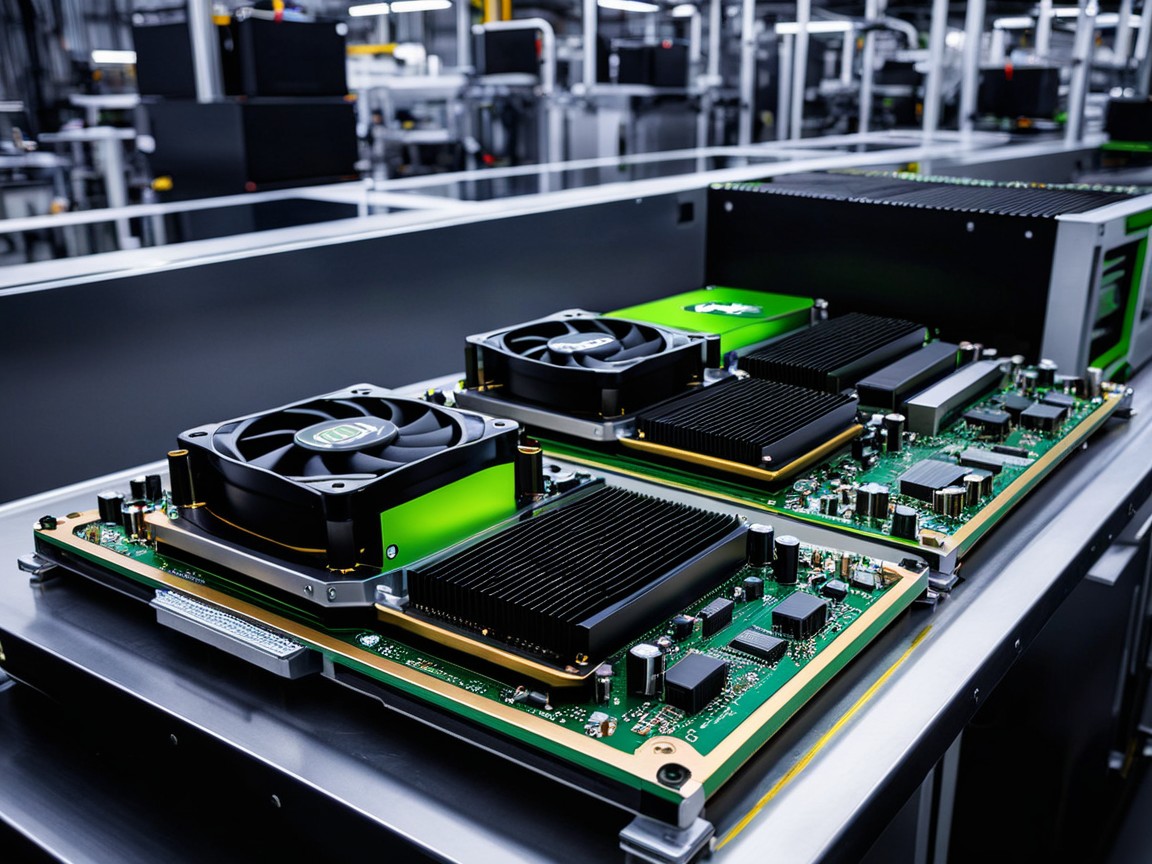
The artificial intelligence revolution has reached an inflection point where computational supremacy directly translates to geopolitical influence. At the epicenter of this technological arms race stands a stark juxtaposition: Nvidia’s latest Blackwell architecture, representing the pinnacle of American semiconductor innovation, and China’s determined pursuit of AI chip independence through indigenous development programs spearheaded by Huawei and emerging players. This semiconductor standoff transcends mere market competition—it embodies a fundamental restructuring of global technology ecosystems that will determine the future landscape of artificial intelligence development.
Nvidia’s Blackwell: Redefining the Upper Bounds of AI Computing
Nvidia’s Blackwell architecture, unveiled at the Graphics Technology Conference in March 2024, represents a quantum leap in AI processing capabilities that fundamentally redefines what constitutes cutting-edge artificial intelligence hardware. Packed with 208 billion transistors, Blackwell-architecture GPUs are manufactured using a custom-built 4NP TSMC process, demonstrating the extraordinary precision required to maintain technological leadership in the AI era.
The architectural innovations embedded within Blackwell extend far beyond raw transistor count. The processor unifies two dies into one GPU, creating a configuration where “the two dies think it’s one chip” with 10 TB/s of inter-die bandwidth. This revolutionary design approach effectively doubles the computational density compared to Nvidia’s previous Hopper architecture while maintaining seamless integration across the unified processing unit.
Performance metrics reveal the transformative nature of Blackwell’s capabilities. The NVIDIA GB300 NVL72 delivers unparalleled AI reasoning inference performance, featuring 65X more AI compute than Hopper systems. This exponential improvement in processing power enables organisations to tackle AI workloads that were previously computationally prohibitive, opening new frontiers in large language model training, scientific simulation, and real-time inference applications.
The commercial implications of these performance gains are profound. Organisations deploying Blackwell-based systems can achieve equivalent computational outcomes with dramatically reduced hardware footprints, translating to lower operational costs, reduced energy consumption, and accelerated time-to-insight for AI-driven initiatives. For enterprises operating at the cutting edge of AI research and deployment, Blackwell represents not merely an incremental upgrade but a fundamental shift in what becomes computationally feasible.
China’s Strategic Response: The Rise of Indigenous AI Silicon
China’s approach to AI chip development reflects a sophisticated understanding that semiconductor independence constitutes a prerequisite for long-term technological sovereignty. Huawei plans to start mass-producing its most advanced artificial intelligence chip in the first quarter of 2025, even as it struggles to make enough chips due to U.S. restrictions, demonstrating remarkable resilience in the face of unprecedented supply chain constraints.

The technical specifications of China’s emerging AI chip ecosystem reveal serious competitive intent. Huawei plans to begin mass shipments of its advanced 910C artificial intelligence chip to Chinese customers, while simultaneously developing the Ascend 910D chip to directly compete with Nvidia’s offerings. These developments suggest a coordinated national strategy to establish comprehensive AI chip capabilities across multiple performance tiers and application domains.
The broader Chinese semiconductor landscape extends beyond Huawei’s efforts. SMIC will have significantly more capacity by 2025 at 5/6/7 nanometers for customers such as Alibaba’s T-Head, GPU leaders Biren Technology and Moore Threads, and other domestic design firms. This diversified ecosystem approach reduces single-point-of-failure risks while fostering competitive dynamics within China’s domestic AI chip market.
Geopolitical Constraints and Market Adaptation
The intersection of technology and geopolitics has created unprecedented challenges for global AI chip distribution. U.S. export controls have forced market participants to develop sophisticated strategies for navigating regulatory constraints while maintaining competitive positioning. Nvidia plans to launch a cheaper Blackwell AI chip for China, based on RTX Pro 6000D with conventional GDDR7 memory instead of more advanced high bandwidth memory, illustrating how regulatory frameworks directly influence product architecture and market segmentation.
These regulatory pressures have inadvertently accelerated China’s domestic innovation timeline. Huawei’s ambitions to create more powerful chips for AI have hit major snags because of US sanctions, stalling efforts to match American technology, yet simultaneously motivating unprecedented investment in indigenous research and development capabilities. This dynamic creates a paradoxical situation where short-term constraints generate long-term competitive pressure.
The economic implications of this bifurcated market structure are substantial. Companies operating in global markets must now develop parallel product lines optimised for different regulatory environments, increasing development costs while potentially fragmenting innovation ecosystems. This fragmentation could lead to the emergence of distinct technological standards and compatibility frameworks, fundamentally altering the trajectory of AI development worldwide.
Architectural Innovations and Technical Differentiation
The technical approaches pursued by American and Chinese AI chip developers reveal fascinating divergences in architectural philosophy. Nvidia’s Blackwell emphasises maximum performance density through advanced manufacturing processes and sophisticated interconnect technologies. Fifth-Generation NVLink supports 1.8TB/s throughput among up to 576 GPUs, enabling massive-scale distributed AI training and inference workloads that approach supercomputer-level performance.
Chinese developers, operating under different constraints, have pursued architectural innovations that optimize for manufacturing feasibility and supply chain resilience rather than absolute performance maximisation. This approach prioritises practical deployment capabilities over theoretical performance peaks, potentially creating solutions that better address real-world operational requirements in specific market segments.
The reliability and maintenance dimensions of AI chip design have become increasingly critical as AI systems transition from experimental implementations to production-critical infrastructure. The RAS engine reduces turnaround time by quickly localising the source of issues and minimises downtime by facilitating effective remediation, reflecting Nvidia’s recognition that enterprise AI deployments require industrial-grade reliability standards.
Market Dynamics and Investment Implications
The AI chip market has experienced unprecedented growth trajectories that defy traditional semiconductor industry expectations. Investors poured money into Nvidia Corp. and made it the world’s most valuable chipmaker, convinced that its lead in artificial intelligence computing would deliver riches. This valuation reflects market confidence in AI’s transformative potential, yet also creates pressure for sustained innovation and market expansion.
The competitive landscape extends beyond traditional semiconductor companies to encompass cloud service providers, technology conglomerates, and government-backed initiatives. This diversification of market participants creates complex dynamics where technical capabilities, manufacturing access, regulatory compliance, and strategic partnerships all influence competitive positioning.
Investment patterns reveal the strategic importance attributed to AI chip capabilities by both private and public sector actors. Government funding for AI chip development has reached unprecedented levels in multiple countries, reflecting recognition that semiconductor capabilities constitute critical national infrastructure in the digital economy era.
Future Trajectory and Strategic Implications
The evolution of AI chip architectures will likely follow divergent paths shaped by regulatory constraints, market access, and technological philosophy. Nvidia’s trajectory emphasises continued performance leadership through advanced manufacturing partnerships and architectural innovation, positioning the company to maintain its dominant position in performance-critical applications.
Chinese AI chip development appears focused on achieving functional parity while building comprehensive domestic supply chain capabilities. This approach prioritises strategic independence over short-term performance advantages, potentially creating sustainable competitive alternatives in specific market segments.
The broader implications of this competition extend far beyond the semiconductor industry. AI chip capabilities directly influence national competitiveness in artificial intelligence research, autonomous systems development, scientific computing, and digital infrastructure modernisation. Countries and companies lacking access to cutting-edge AI processing capabilities may find themselves at fundamental disadvantages in the digital economy.
The New Geometry of Technological Competition
The battle between Nvidia’s Blackwell architecture and China’s emerging AI chip ecosystem represents more than a traditional technology competition—it embodies the reconfiguration of global innovation dynamics in an era of technological nationalism. The outcomes of this competition will determine not only market share distributions but also the fundamental architecture of the global AI ecosystem.
For technology leaders and investors, understanding these dynamics requires moving beyond traditional performance metrics to consider geopolitical sustainability, supply chain resilience, and regulatory compliance as core evaluation criteria. The most successful organisations will be those that can navigate this complex landscape while maintaining access to the computational resources necessary for AI innovation.
The semiconductor industry has entered a new era where technical excellence alone is insufficient for market success. The integration of geopolitical strategy, manufacturing resilience, and architectural innovation has become the defining challenge for AI chip developers worldwide. The companies and countries that master this multidimensional competition will shape the future of artificial intelligence and, by extension, the trajectory of human technological development.