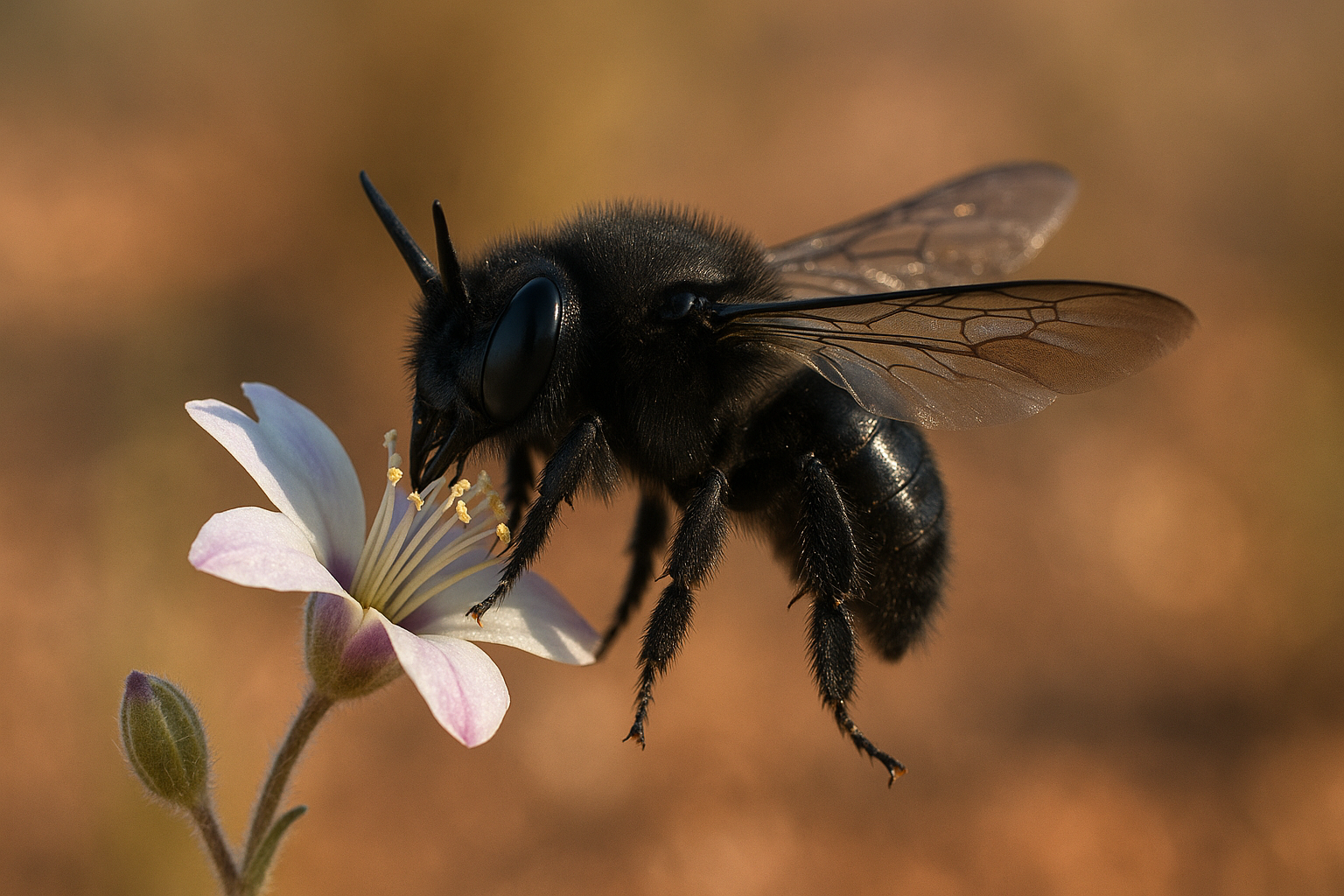
Demonic Horns and Biodiversity Crisis: Australia’s Newly Described Lucifer Bee
In the arid expanses of Western Australia’s Goldfields region, a remarkable discovery has illuminated both the extraordinary diversity of Australia’s native pollinators and the precarious state of species yet to be formally documented by science. Researchers have described a new bee species bearing distinctive horn-like structures on its face, christened Megachile (Hackeriapis) lucifer—the Lucifer bee. This discovery, published in the Journal of Hymenoptera Research in 2025, represents the first new member of its taxonomic group identified in more than two decades and underscores a troubling reality: threatened landscapes harbour species unknown to science, and industrial development may be eliminating them before they can be studied.
An Unexpected Discovery in a Threatened Landscape
The Lucifer bee first came to scientific attention in 2019 during fieldwork conducted by Dr Kit Prendergast, an Adjunct Research Fellow at Curtin University’s School of Molecular and Life Sciences. Dr Prendergast was surveying populations of Marianthus aquilonarius, a critically endangered wildflower, in the Bremer Range region between Norseman and Hyden, approximately 470 kilometres east of Perth. Whilst documenting plant-pollinator interactions, she observed unusual black bees visiting both the endangered wildflowers and nearby mallee trees. Initial examination revealed striking sexual dimorphism: female specimens possessed prominent, horn-like projections extending from their faces, measuring approximately 0.9 millimetres in length, whilst males lacked these structures entirely.
The distinctive morphology suggested an undescribed species, but confirmation required rigorous scientific verification. DNA barcoding of both male and female specimens confirmed they belonged to the same species despite their markedly different appearances. Crucially, the genetic sequences matched nothing in existing databases, and morphological comparison with museum collections yielded no counterparts. These findings, combined with detailed anatomical analysis, established that the specimens represented a genuinely novel species—one that had been visiting critically endangered plants without scientific documentation.
Taxonomic Significance and Evolutionary Context
Megachile lucifer belongs to the Megachilidae family, commonly known as leafcutter bees, which comprises over 1,500 species globally within the Megachile genus alone. The new species represents a member of the Hackeriapis subgenus, a group that has yielded no new species descriptions for more than 20 years. This taxonomic drought makes the discovery particularly significant, suggesting either genuine rarity or, more troublingly, insufficient survey effort in potentially species-rich regions.
The facial horns that distinguish female Lucifer bees serve unknown functions. Sexual dimorphism in insects often relates to reproductive behaviour, territorial defence, or specialised foraging. The horns’ prominence on females but absence in males suggests possible roles in nest construction, defence of nesting sites, or inter-female competition for limited resources. However, without detailed behavioural observations—challenging to obtain for a species with such limited known distribution—these remain speculative hypotheses requiring further investigation.
The species’ common name derives from Latin lucifer, meaning “light-bringer,” chosen both for the bee’s devilish appearance and to illuminate the urgent need for native bee conservation. The cultural reference to contemporary television reflects a deliberate effort to generate public interest in taxonomic research, which faces chronic underfunding despite its foundational importance to conservation biology.
Ecological Role and Conservation Implications
The Lucifer bee appears intimately associated with the very habitat where it was discovered. Observed visiting the critically endangered Marianthus aquilonarius, it may represent a crucial pollinator for this threatened plant species. Plant-pollinator mutualisms form the backbone of terrestrial ecosystems, and the loss of specialist pollinators can precipitate cascading extinctions. If M. lucifer proves to be a specialist or particularly effective pollinator of endangered flora, its own conservation becomes inseparable from broader efforts to preserve threatened plant communities.
This ecological interdependence highlights a fundamental challenge in conservation biology: species are not isolated entities but components of intricate networks. The Goldfields region, whilst recognised for its botanical endemism, has received far less attention regarding invertebrate diversity. The discovery of M. lucifer suggests that biodiversity surveys focused narrowly on charismatic flora or fauna may miss cryptic species with critical ecological functions. Mining assessments in the region typically do not include comprehensive native bee surveys, despite these insects’ irreplaceable roles in ecosystem function.
Australia hosts approximately 2,000 described native bee species, yet this figure grossly underestimates true diversity. More than 300 species—representing roughly 15 per cent of the known fauna—await formal scientific description. The Commonwealth Scientific and Industrial Research Organisation (CSIRO) characterises Australian native bees as “understudied and data poor,” with insufficient knowledge to assess the conservation status of the vast majority. This taxonomic impediment is not merely an academic concern: species cannot be protected under legislation until they are formally described, and their ecological requirements cannot be accommodated in land management without basic biological knowledge.
Industrial Threats and the Race Against Extinction
The Goldfields region where M. lucifer was discovered faces intense pressure from mining activities. Western Australia’s resource extraction industry, whilst economically significant, fragments habitats and alters landscapes in ways that disproportionately affect species with limited distributions. For bees requiring specific floral resources or nesting substrates, even localised habitat degradation can prove catastrophic. Climate change compounds these pressures, threatening both the bees and the endangered wildflowers they pollinate through altered flowering phenology, increased drought severity, and habitat shifts that may exceed species’ dispersal capabilities.
The temporal gap between the Lucifer bee’s initial observation in 2019 and its formal description in 2025 illustrates the bottleneck in taxonomic research. Describing a new species requires extensive comparative work, molecular analysis, and preparation of detailed documentation for peer review—all resource-intensive processes. During this six-year interval, the species’ habitat remained vulnerable to disturbance without any formal recognition of the bee’s existence. This lag exemplifies a broader crisis: biodiversity is being lost faster than it can be documented, with species potentially vanishing before science records their existence.
Mining companies operating in biodiversity hotspots face ethical and regulatory obligations to minimise environmental harm, yet comprehensive invertebrate surveys remain uncommon in environmental impact assessments. This oversight stems partly from the expertise required to identify native bees, many of which are morphologically similar and require specialist taxonomic knowledge to distinguish. The discovery of M. lucifer during botanical fieldwork, rather than dedicated entomological survey, suggests that current biodiversity assessment protocols may be inadequate for detecting cryptic but ecologically significant species.
Broader Implications for Biodiversity Science
The Lucifer bee’s discovery resonates beyond Australian entomology, embodying global challenges in biodiversity conservation. As the Anthropocene epoch accelerates, scientists race to document species before they vanish—a discipline sometimes called “extinction biology.” Each newly described species raises uncomfortable questions: how many others remain unknown? How many have already been lost without record? In tropical and arid regions where survey effort is limited, cryptic species with restricted ranges face elevated extinction risk.
The announcement of M. lucifer during Australian Pollinator Week underscores growing recognition of native pollinators’ ecological and economic importance. Whilst European honeybees dominate agricultural pollination, native bees often prove more effective pollinators of indigenous flora and can provide complementary pollination services in crop systems. Understanding native bee diversity, distributions, and ecological requirements is thus essential not only for conservation but for food security and ecosystem resilience.
The integration of molecular techniques with traditional morphological taxonomy has accelerated species discovery and refined our understanding of evolutionary relationships. DNA barcoding, which confirmed that M. lucifer’s sexually dimorphic forms belonged to a single species, exemplifies how genetic tools resolve taxonomic uncertainties. However, these technologies require substantial investment in reference collections, sequencing infrastructure, and bioinformatics expertise—resources unevenly distributed globally. Australia’s relatively strong scientific capacity enabled M. lucifer’s description, but countless species in less-studied regions likely remain undetected.
Future Directions and Conservation Imperatives
The description of Megachile lucifer opens numerous research avenues whilst highlighting urgent conservation needs. Detailed studies of the species’ life history, nesting biology, floral preferences, and population dynamics are essential for assessing its conservation status and informing management strategies. Surveys across the Goldfields region could establish whether the species occurs more widely than currently known or whether its distribution is genuinely restricted to the small area where it was discovered. Understanding its relationship with Marianthus aquilonarius and other flora would clarify its ecological niche and potential vulnerability to environmental change.
Broader systematic surveys of Australian native bees are critically needed. The 300-plus undescribed species represent a substantial knowledge gap, and the true figure may be considerably higher. Investing in taxonomic research, training new specialists, and digitising museum collections would accelerate species documentation and improve conservation planning. Integrating native bee surveys into environmental impact assessments, particularly in biodiversity hotspots facing development pressure, could prevent inadvertent extinctions and ensure that land-use decisions account for invertebrate diversity.
Policy frameworks must evolve to address the paradox of protecting species whilst they remain scientifically undescribed. Precautionary approaches that preserve habitat based on its biodiversity potential, rather than awaiting comprehensive species inventories, may prove essential in rapidly changing landscapes. Conservation strategies increasingly emphasise ecosystem-level protection, which can safeguard unknown species alongside documented ones, but this requires political will and adequate funding.
Conclusion: Light in Dark Times
The Lucifer bee, with its minute demonic horns and uncertain future, embodies both the wonder of biological diversity and the fragility of life in the Anthropocene. Its discovery in a threatened landscape, visiting a critically endangered plant, illustrates how ecological crises intertwine. As climate change intensifies and industrial development extends into previously undisturbed regions, the imperative to document and protect biodiversity becomes ever more urgent.
This small black bee, unknown to science until recently, may yet illuminate broader truths about conservation priorities and the value of biodiversity research. Its formal description provides a foundation for protection, but only if accompanied by genuine commitment to preserving the habitats that sustain both described and yet-undiscovered species. In the arid expanses of Western Australia, and in threatened ecosystems globally, countless species await discovery. The question facing contemporary conservation biology is whether we can document and protect them before they vanish—or whether future generations will know them only through their absence.
The Lucifer bee’s story is ultimately one of hope tempered by urgency: hope that dedicated researchers continue revealing nature’s hidden diversity, and urgency because time grows short for species teetering on the brink of extinction. In shining light on this remarkable insect, science has created an opportunity for conservation action. Whether that opportunity is seized will determine not only the fate of Megachile lucifer but the broader trajectory of biodiversity protection in an era of unprecedented environmental change.