Anniversaries are supposed to offer a kind of accounting — a moment to tally what has changed, what has held, what has been lost. On 15 August 2026, Afghanistan reaches one of the starker such moments of the past decade: five years to the day since the Taliban swept back into Kabul, as the final American and NATO forces withdrew after nearly two decades of war. It is tempting, at the five-year mark, to treat the story as concluded — a chapter the West closed on a specific date in August 2021, filed under “over.” The trouble is that Afghanistan’s story did not close. It has continued, largely out of Western headlines, and what has continued is one of the gravest and most systematically constructed human rights crises anywhere in the world today.
The Fall, Revisited
It is worth being precise about what actually happened five years ago, because the manner of the collapse still shapes how the anniversary is discussed. The Taliban’s return to power was startlingly fast — a campaign of provincial capitulations and negotiated surrenders that culminated in the fall of Kabul on 15 August 2021, catching much of the Afghan government, and reportedly much of Washington, off guard. What followed was a chaotic evacuation, culminating on 26 August 2021 in a suicide bombing at Kabul airport’s Abbey Gate, where crowds of Afghans desperate for evacuation had gathered alongside US troops managing the crush. The attack, claimed by the Islamic State’s regional affiliate, ISIS-K, killed thirteen American service members and roughly 170 Afghan civilians, and wounded around 45 more US personnel. The withdrawal concluded on 31 August 2021, the last cargo aircraft lifting off from a country that, for the first time in two decades, had no Western military presence at all.
The Abbey Gate bombing has remained a live wound in American political memory rather than a settled historical footnote — revisited in subsequent Pentagon reviews, congressional hearings, and testimony from wounded service members, with responsibility for the chaos of those final weeks contested along predictably partisan lines ever since. That dispute over blame is not likely to be resolved by this anniversary, and it is not, in truth, the most urgent question the date raises. The more urgent question is what happened afterwards, to the roughly 40 million people who did not get on a plane.
A Rights Framework, Dismantled Piece by Piece
Between 2001 and 2021, Afghanistan built something real, if never fully realised: a legal architecture that moved, however unevenly, in the direction of equality. The 2004 constitution guaranteed equal rights between men and women. Courts, however imperfect, employed female judges — roughly 270 of them by 2021. Girls attended secondary school in numbers that would have been unthinkable a generation earlier; by the time Kabul fell, close to a million of them were enrolled.
Since 15 August 2021, the Taliban’s de facto authorities have issued close to a hundred edicts, decrees, and directives that between them have dismantled nearly all of it. Women’s voices have been restricted in public. A justice system has been rebuilt from the ground up, with every one of those roughly 270 female judges dismissed and replaced exclusively by Taliban-affiliated men, many without formal legal training, adjudicating according to Taliban edicts rather than any codified law — including, notably, with no minimum age set for marriage. Women were told in November 2021 to stay away from their civil service jobs; by January 2026, they had been formally struck from the government payroll altogether, some discovering their own dismissal only when a salary payment failed to arrive. Women have been barred from working for non-governmental organisations since December 2022, and from working for the United Nations itself since April 2023. The cumulative effect, according to recent UN figures, is that close to 80 percent of young Afghan women are now neither in education, nor in employment, nor in any form of training — against roughly 20 percent of young men facing the same circumstance. The UN’s agency on women’s rights has put this plainly: Afghan women and girls are living, right now, under the most severe restrictions imposed on any population of women anywhere in the world.
A Cohort That Simply Missed School
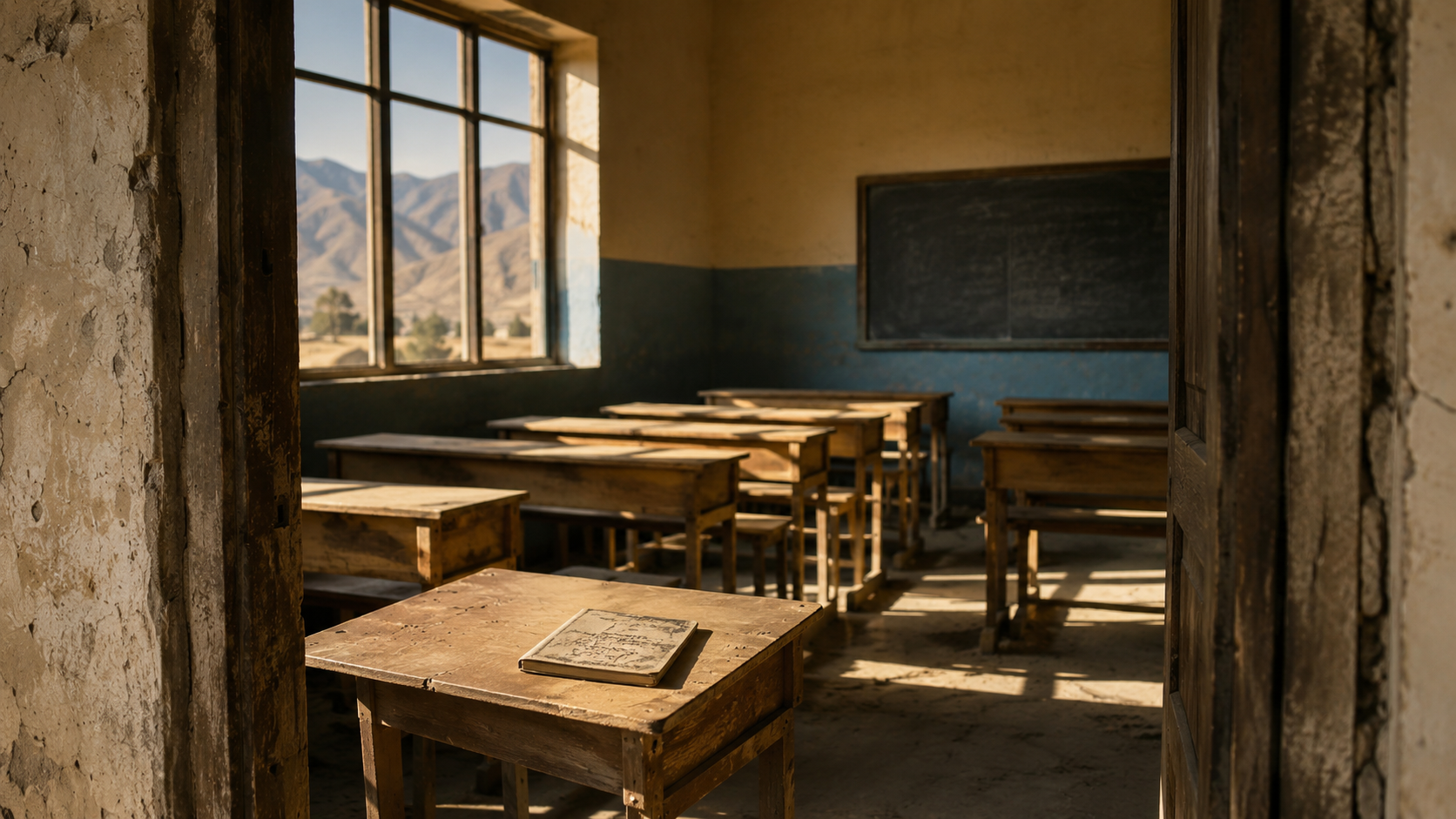
Of all these restrictions, it is the education ban that carries perhaps the clearest generational arithmetic, because it is measured not in policy abstractions but in years a child does not get back. Afghanistan is, at this anniversary, the only country on earth where girls are formally barred from secondary and higher education. The ban did not arrive instantly or without a cruel false start: having initially pledged that girls would return to secondary school at the beginning of the new academic year, the Taliban reversed the decision at the school gates in March 2022, after girls had already turned up, in some cases in their best clothes, only to find the doors locked. Universities were closed to women that December; by January 2023, women were barred even from sitting the entrance examinations that might once have got them there.
UNESCO now estimates that some 2.4 million Afghan girls remain shut out of secondary education five years on — and its own officials have been careful to frame what that number actually represents. It is not, as UNESCO’s programme coordinator for education in emergencies has put it, a temporary interruption in a child’s schooling. It is functionally an entire secondary cycle, gone. A girl who was eleven when the ban began is now sixteen, and has never sat in a secondary classroom under this government. The progress Afghanistan made over two decades — expanding girls’ access to education from a near-total historical absence to near-a-million enrolled — has, in UNESCO’s own assessment, been completely reversed. There is a second, quieter casualty here too: reporting from inside the country has documented a less-discussed drift of boys away from formal schooling as well, as curricula shift toward religious instruction and the wider promise of education erodes for everyone, not only for girls.
The Anniversary’s Uncomfortable Double Message
What makes this anniversary genuinely difficult to write about honestly is that it does not offer a single, clean narrative. Alongside the accounts of dismantled rights are, this same week, reports from Kabul of residents who describe feeling safer than they have in decades — an unglamorous but real byproduct of the war’s end, after forty years of near-continuous conflict. The Taliban government itself points to a stabilised currency, expanded infrastructure, and industrial development as evidence of competent governance. The United Nations’ own mission in the country has acknowledged that a reduction in fighting has brought tangible benefits and created space for recovery and regional economic engagement that a live civil war made impossible.
But the same UN mission has been equally clear that this stability is provisional and incomplete so long as it rests on the exclusion of half the population from public life. Lasting stability, in its assessment, cannot be built while women and girls remain locked out of education, work, and the courts, and while the government responsible for that exclusion remains diplomatically isolated, unrecognised by the overwhelming majority of the international community. This is the genuine dilemma facing governments, aid agencies, and multilateral bodies watching this anniversary pass: whether continued isolation of the Taliban punishes the government responsible for these policies, or simply removes what little leverage anyone outside Afghanistan retains to argue for their reversal — and whether engagement, conversely, risks conferring legitimacy on a government that has spent five years demonstrating precisely what it intends to do with it.
What the Date Is Actually For
There is a reason five-year anniversaries carry particular weight in how we process a crisis: they mark the point at which “recent” quietly becomes “ongoing,” and ongoing crises are, inconveniently for news cycles, much harder to sustain attention for than sudden ones. The images that defined August 2021 — aircraft doors closing on desperate crowds, the aftermath at Abbey Gate — were the kind of images that generate headlines. The image that actually defines August 2026 is much harder to photograph: a sixteen-year-old girl in Kabul or Herat or Kandahar who has simply never been allowed back into a secondary school classroom, and the several million others like her, whose lost years will not arrive as breaking news, because nothing, from the outside, appears to be happening to them at all. That, more than any single statistic, is what this particular anniversary is for: a deliberate pause to notice what silence has been quietly accumulating into, five years on from a day the rest of the world has mostly moved past.