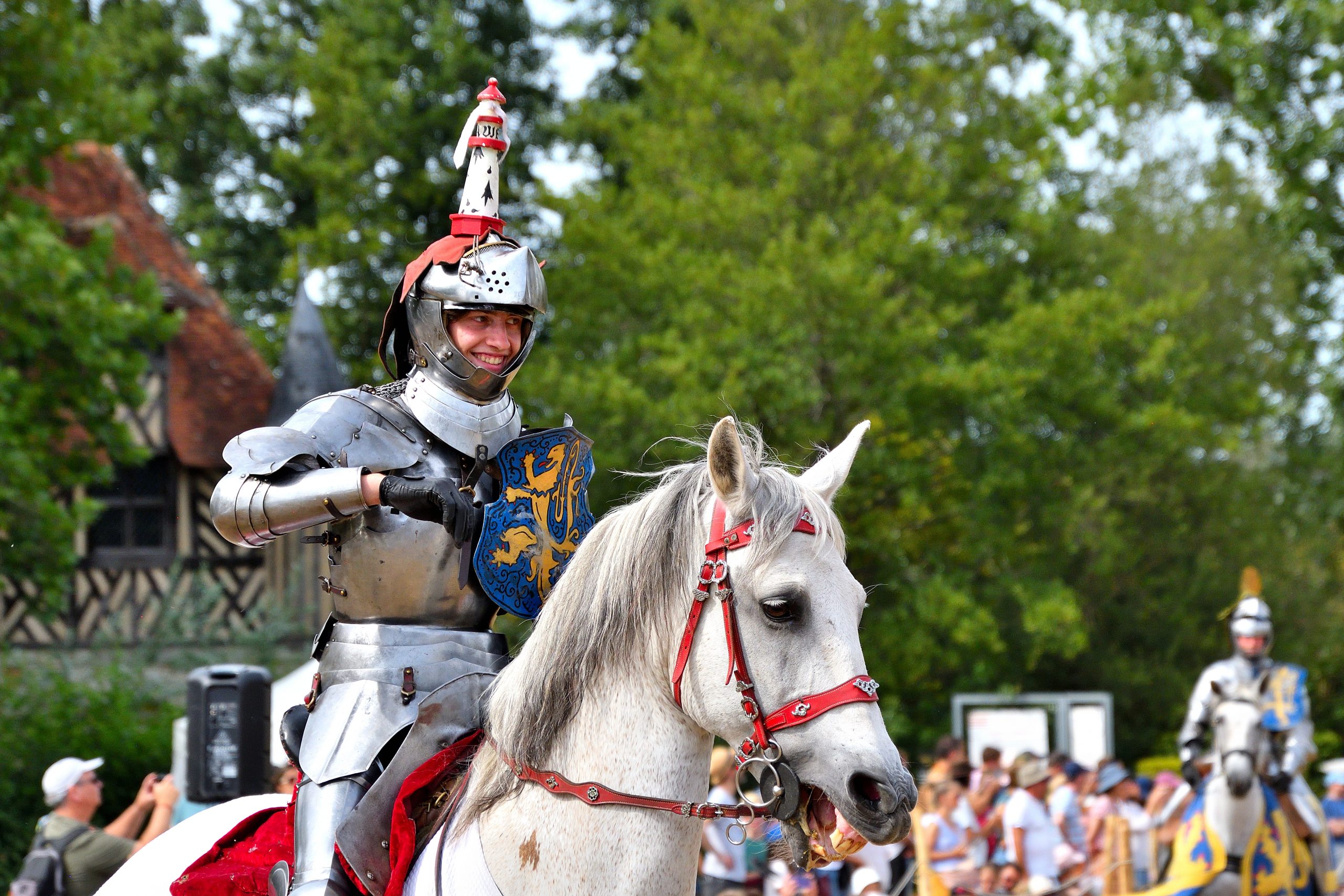
There is a particular kind of vertigo that comes from standing inside a moat. Not beside one, admiring it from a safe and photogenic distance, but genuinely enclosed by it — timber and stone rising on every side, the modern world reduced to a distant hum beyond the water. At the Château de Crèvecœur-en-Auge, a rural seigneurie in Normandy’s Pays d’Auge that has survived, more or less intact, since the fifteenth century, this vertigo is precisely the point. From 3 to 10 August 2026, the château stages Les Médiévales de Crèvecœur, an eight-day historical reenactment festival in which roughly sixty costumed participants attempt something more ambitious than mere pageantry: they try to reconstruct the texture of a working manorial household on the cusp of the harvest, around the year 1474.
It would be easy to file this under the broad and slightly tired heading of “medieval fun days” — jousting, mead, and a man in chainmail selling fudge. Crèvecœur’s organisers clearly understand the temptation and, to their credit, largely resist it. What distinguishes this festival, and what makes it worth a longer look than the average summer listings entry, is its willingness to treat the period it reenacts as a coherent social and economic system rather than a costume rack. The choice of theme for 2026 — the preparations for a harvest festival — is a quietly intelligent one, because it puts agricultural labour, rather than knightly combat, at the centre of the story, even as the jousting tournaments supply the spectacle that draws the crowds through the gate.
Normandy After the War
To understand why a harvest matters so much in this particular setting, it helps to remember what Normandy had just been through. By 1474, the region was barely two decades removed from the end of English occupation. Rouen had fallen back under French control in 1449, and the last English strongholds in Normandy were extinguished shortly after, sealing a reunification with the French crown that had been contested, on and off, for well over a century. The Hundred Years’ War, in other words, was recent history for the generation notionally depicted at Crèvecœur — not a distant memory but something their parents had lived through, fought in, or fled from.
What followed occupation and war was not instant recovery but a long, uneven process of resettlement. Fields that had lain fallow through decades of campaigning needed workers again; manorial estates needed to reassert the customary obligations — labour dues, rents in kind, tithes — that bound tenants to their lords and, by extension, to the rhythm of the agricultural year. A rural seigneurie like Crèvecœur would have depended on precisely this reassertion for its own survival. The harvest was not simply a farming event; it was the annual proof that the manorial system still functioned, that the obligations flowed correctly from field to barn to lord’s table to church tithe-barn, and that a community battered by war could still feed itself. Framing the festival around harvest preparation, then, is not a whimsical theme choice so much as a genuinely apt one: it puts the audience inside the anxious, hopeful machinery of post-war rural recovery, rather than merely inside a knight’s tent.
This is also where the festival’s daily rhythm does its most interesting work. Between 11am and 7pm each day throughout the week, visitors are not simply spectators wandering past static displays; they are drawn into interactive investigations, in which reenactors playing specific characters within the household engage the public directly, dropping clues and posing riddles connected to whatever is quietly disturbing the peace of the seigneurie. It is a device borrowed as much from participatory theatre as from conventional heritage interpretation, and it reflects a broader shift in how historical sites now try to reach audiences: not through glass cases and laminated signage, but through embodied, slightly chaotic contact with people who are, for a week, pretending rather convincingly to be someone else. Alongside these investigations run demonstrations of craft, cookery, and the unglamorous mechanics of daily medieval life — the sort of detail that rarely makes it into films about the period but that governed how most people actually spent their time.
Lances, Honour, and a Sport Reborn
The tournaments that open the week, staged on 3 and 4 August with performances at 2.30pm and 4.30pm, represent the festival’s most theatrical register, and it is worth pausing on what jousting actually meant in the century being reenacted, because its function was never purely martial. By the later fifteenth century, the joust had long since evolved from a training exercise for war into an elaborate instrument of aristocratic display — a means by which noble families advertised wealth, cultivated alliances, and negotiated status through a form of violence so heavily ritualised and regulated that it functioned almost as diplomacy conducted with lances. To sponsor or excel at a tournament was to make a public statement about one’s standing in a hierarchy that was, in truth, being renegotiated constantly. In a Normandy still settling scores and reassembling loyalties after decades of war, that function of controlled, spectacular display would have carried particular weight.
Chevalerie Initiatique: Reviving a Sport, Not Just a Show
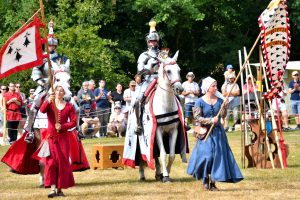 The tournaments themselves are staged by La Chevalerie Initiatique, a Normandy-based cultural association founded in 1996 by Arnaud Léon, now its honorary president, and worth understanding on its own terms rather than simply as festival entertainment. The association is explicit that it does not exist to train stunt performers or stage swordfighters — those, its members note, are the domain of other professionals — but to revive equestrian jousting as a genuine, judged sport rooted in fifteenth-century practice. Since its founding, the group has staged more than four hundred tournaments across Europe and, by its own count, broken upward of ten thousand lances, competing in both a safety-oriented “courteous” format using balsa-tipped lances and a more historically faithful version using single-piece wooden lances. Its riders compete in reconstructed fifteenth-century armour weighing close to thirty-five kilograms, some elements modelled on pieces its members studied at the Musée de l’Armée at Les Invalides in Paris, and contest skill events — the quintain, ring-tilting, apple-spearing — that were themselves training exercises for medieval knights long before they became festival crowd-pleasers. A maître de lice judges the events and tallies points, which is a small but telling detail: this is presented, deliberately, as sport with rules and outcomes, not choreography. The association has partnered with several of France’s most significant historic sites, including the châteaux of Brézé, Le Rivau, and Harcourt, and has supplied horses and riders for French television productions including Secrets d’Histoire. Their presence at Crèvecœur situates the festival within a wider, and still growing, movement of “living history” practitioners across Europe who treat reenactment not as fancy dress but as a discipline — part historical research, part athletic training, part public performance.
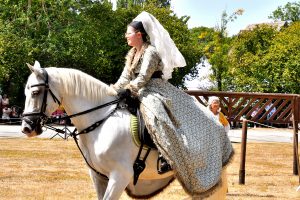 That movement is itself worth a moment’s reflection, because it says something about how contemporary audiences relate to the past. Conventional museum display asks visitors to look; living history asks them to stand inside the scene, to be addressed by a character rather than a caption, to smell the beef pâtés and Lombard chicken being prepared from recipes drawn from period manuscripts rather than read about them on a placard. This is not without its tensions — authenticity and entertainment pull in different directions, and any reenactment inevitably smooths over the discomfort, disease, and social violence of the period it recreates. But at its best, as Crèvecœur seems to aim for, it offers something documentary history struggles to provide: a visceral, if partial, sense of how ordinary time actually passed for people who left few written records of their own.
The Château Itself
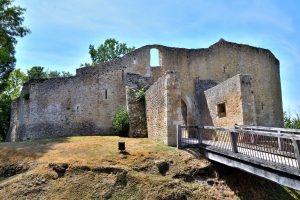 None of this would carry the same weight without the setting. The Château de Crèvecœur-en-Auge is unusual precisely because it has not been heavily reconstructed or reinvented for tourism; it retains its original layout, with the seigneurial manor house, a chapel, and timber-framed farm buildings arranged around the moat that still encircles the site. Rural seigneuries of this scale and completeness are relatively rare survivors in Normandy, a region whose built heritage was repeatedly battered by war across several centuries, which makes the château less a backdrop than a genuine historical document in stone and timber — one the festival is, in effect, reading aloud for a week each summer.
Practicalities
The 2026 edition runs from Monday 3 to Monday 10 August, open daily from 11am to 7pm, at the Château de Crèvecœur, Route de Paris, in Crèvecœur-en-Auge (commune of Mézidon Vallée d’Auge), roughly twenty kilometres from Lisieux and thirty from Caen, just off the A13. Admission is €12 for adults and €6 for the reduced rate (ages five to eighteen, and visitors with disabilities); a family pass covering two adults and two or three children costs €35, though it is not valid on the two tournament days. Free parking is available on site.
For a visual sense of what a week inside the fifteenth century actually looks like, the Normandy-based photographer René Cortin, of Lisieux, has documented the festival in a photo album well worth browsing before — or after — a visit: flic.kr/s/aHBqjD1BuG.