A Nation Caught Between Geological Fortune and Ecological Fragility
In the southern reaches of Greenland, where ancient ice meets exposed bedrock, lies Kvanefjeld—a mountain containing one of the world’s largest deposits of rare earth elements. For fifteen years, Australian mining firm Energy Transition Minerals invested millions drilling, sampling, and preparing to extract the neodymium and dysprosium locked within this geological formation. Then, in 2021, newly elected Prime Minister Muté B. Egede’s government banned uranium mining, effectively terminating the project. The company now seeks $11.5 billion in compensation—nearly four times Greenland’s annual GDP.
This confrontation crystallises the existential dilemma facing the world’s largest island. Greenland possesses extraordinary mineral wealth at precisely the moment global demand for these resources reaches fever pitch. Yet the 57,000 predominantly Inuit people who call this territory home find themselves contemplating a Faustian bargain: whether to exploit deposits that could fund independence from Denmark, or preserve an Arctic ecosystem already under siege from climate change. The question transcends Greenland’s shores, offering a sobering preview of resource conflicts certain to intensify as the planet warms and ice-locked treasures become accessible.
The Geological Lottery: An Inventory of Frozen Wealth
Greenland’s resource endowment reads like a mining executive’s fever dream. A 2023 survey identified 25 of the 34 minerals deemed critical by the European Commission, including rare earth elements, graphite, lithium, uranium, zinc, lead, gold, rubies, and substantial hydrocarbon reserves. The Kvanefjeld deposit alone holds an estimated 40 million tonnes of rare earth elements—sufficient to satisfy more than a quarter of projected global demand for dysprosium and neodymium. These materials form the technological sinew of contemporary civilisation: permanent magnets for electric vehicle motors, components for wind turbine generators, semiconductors for mobile devices, and guidance systems for precision weaponry.
Climate change functions as both accelerant and enabler. Since 1995, ice coverage equivalent to Albania’s landmass has melted, exposing mineral deposits previously entombed beneath kilometres of frozen water. Ground-penetrating radar now allows geologists to survey bedrock beneath 2,000 metres of ice cover with increasing precision, revealing formations shaped by four billion years of mountain building, crustal rifting, and volcanic activity. The Gardar province in southern Greenland—home to the Tanbreez and Kuannersuit projects—represents geological processes extraordinarily rare on Earth: the convergence of compressive mountain formation, extensional rifting, and igneous intrusions that concentrate commercially viable minerals.
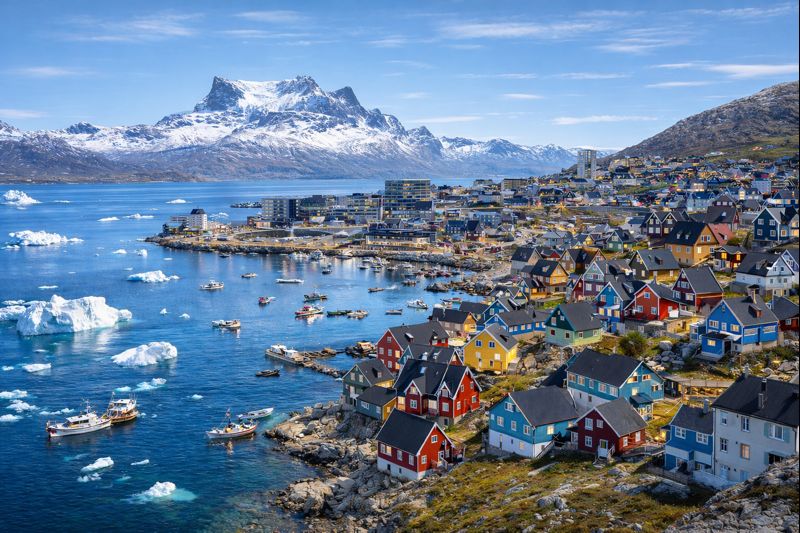
Yet this abundance remains largely theoretical. Despite intensive prospecting, only one mine currently operates in Greenland—extracting anorthosite for rock wool insulation. The Black Angel mine, which produced lead and zinc from 1973 to 1990, left contamination that persists five decades later, whilst rubies and sapphires ceased commercial extraction in 2023. Oil and gas exploration stands prohibited since 2021, with officials citing climate concerns. Infrastructure constraints prove formidable: Greenland’s 70 settlements remain unconnected by roads, travel occurs by boat or helicopter, and northern villages endure ice-lock for months annually whilst experiencing permanent darkness through winter.
The Corporate Interest: Geopolitics Masquerading as Commerce
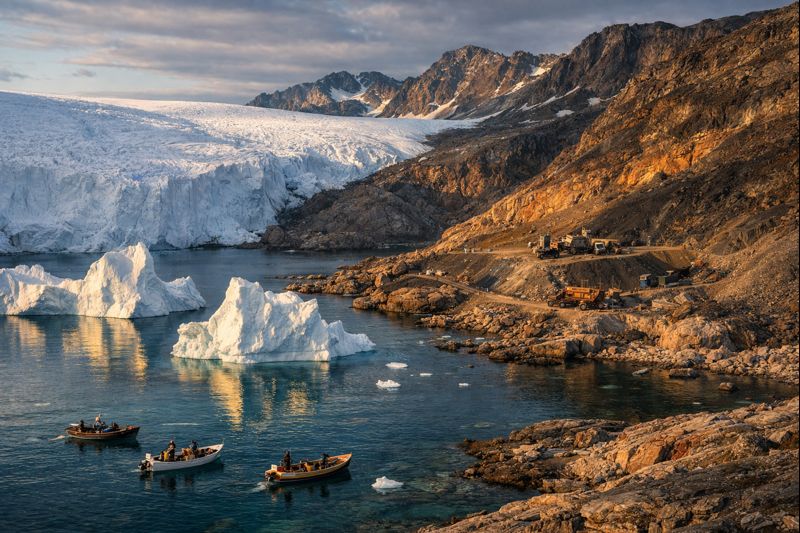
Greenland’s strategic significance extends beyond its mineral inventory. Positioned between the United States and Russia, the territory controls emerging Arctic shipping lanes where melting ice promises to reduce Asia-Europe transit times dramatically compared to the Suez Canal route. This geography, combined with resource wealth, has catalysed intense geopolitical manoeuvring. The European Union and United States have signed mining agreements with Greenland, whilst China—despite growing tensions—maintains a 12.5 per cent stake in the Kvanefjeld project through Shenghe Resources and has pursued airport infrastructure and satellite ground station investments, albeit largely stalled by Danish and American intervention.
Critical Metals Corporation, Energy Transition Minerals, and Neo Performance Materials now explore Greenland’s rare earth deposits, their interest amplified by China’s near-monopoly on processing—Beijing controls approximately 90 per cent of global rare earth refining capacity. This concentration grants China extraordinary leverage over supply chains essential for renewable energy systems and defence applications. Greenland’s reserves represent a potential counterweight, yet experts remain deeply sceptical. Professor John Mavrogenes of Australian National University notes that whilst Greenland hosts vast volumes of rare-earth-bearing rock, concentrations remain far below economically viable grades. Productive mines typically contain 3 to 6 per cent rare earth content; Greenland’s deposits often measure barely 1 per cent, requiring ten times the rock volume to be moved—in terrain lacking infrastructure, equipment, or skilled workforce.
Even optimistic projections suggest a decade before meaningful production, rendering Greenland’s deposits strategically irrelevant for addressing immediate supply vulnerabilities. Processing capacity, not raw ore availability, constitutes the genuine bottleneck. Extracting ore represents merely the first stage; separation and refinement into usable metals demands sophisticated chemical processes China has perfected over decades. Without comparable processing infrastructure outside China, Greenland’s minerals would likely flow to Chinese refineries regardless, undermining the strategic independence rationale driving Western investment.
The Environmental Reckoning: Pollution in Perpetuity
The environmental stakes could scarcely be higher. Greenland’s Arctic ecosystem functions at the planetary climate system’s frontline—its ice sheet contains sufficient water to raise global sea levels over six metres if fully melted, whilst accelerating ice loss already disrupts ocean circulation patterns and weather systems worldwide. Large-scale mining would compound these stresses catastrophically. Open-pit operations scar landscapes permanently, whilst tailings dams containing radioactive and toxic wastewater pose collapse risks—events that have devastated communities worldwide.
Greenland’s troubled mining history provides sobering precedent. Remnants from 1970s lead and zinc operations continue contaminating soil and water, threatening marine ecosystems upon which traditional Inuit livelihoods depend absolutely. Seal hunting, whale harvesting, and fishing constitute not merely economic activities but cultural practices extending back millennia. The fishing industry alone employs 6,500 people—over 11 per cent of the population—and accounts for approximately 90 per cent of exports. Coastal villages averaging 150 inhabitants rely entirely on marine resources for sustenance and income. Mining pollution would jeopardise these fisheries through heavy metal accumulation, acid drainage, and sediment loading, potentially rendering waters unsuitable for the cold-water shrimp, halibut, and cod species dominating Greenland’s catches.
The Kvanefjeld project exemplifies these hazards. Extracting rare earths would necessarily entail uranium mining—the deposits are co-located—generating radioactive tailings requiring permanent containment. Thorium, far more abundant than uranium in rare earth minerals yet less discussed, presents additional radiological risks inadequately addressed in environmental assessments. Local communities near Greenland’s only farmland organised fierce opposition, recognising that contamination could render agricultural land unusable whilst threatening drinking water supplies and subsistence hunting grounds. Their political mobilisation produced the 2021 uranium ban—a democratic assertion of environmental sovereignty over corporate profit.
The Distribution Question: Who Benefits from Buried Treasure?
The promise of mining revenues funding Greenlandic independence possesses superficial appeal. Currently, Denmark provides approximately half of government revenues—roughly €600 million annually—creating fiscal dependency that constrains political autonomy. Mining royalties and taxation could theoretically replace Danish subsidies, enabling full sovereignty whilst generating employment in communities suffering unemployment rates far exceeding European averages. The Kuannersuit project, had it proceeded, was projected to generate $220 million annually—approximately 7 per cent of GDP—whilst creating hundreds of jobs in a nation of 57,000.
Yet historical evidence from resource-rich developing nations suggests this optimism borders on delusion. The “resource curse” literature documents how natural resource wealth frequently produces poverty rather than prosperity. Nigeria ranks 159th of 182 nations on the Human Development Index despite vast oil reserves. The Democratic Republic of Congo possesses extraordinary cobalt, copper, and diamond deposits yet endures persistent conflict and state failure. Zambia’s copper industry generated modest returns that failed to catalyse broader economic development, whilst Venezuela’s oil abundance preceded economic collapse of historic proportions.
Multiple mechanisms drive these outcomes. Extractive industries require specialised expertise, leading governments to grant concessions to foreign multinationals that capture the bulk of profits through favourable tax arrangements, transfer pricing, and limited local reinvestment. Zambia doubled mining tax revenue in 2011 by simply imposing a 30 per cent levy—demonstrating how inadequate initial taxation had been. Resource dependence distorts economies, crowding out diversified industries whilst creating vulnerability to commodity price volatility. When prices rise, governments increase spending unsustainably; when prices collapse, budgets contract sharply, producing economic shocks and social instability. Easy resource wealth also correlates with authoritarian governance, as political leaders resist democratic development to retain control over lucrative extraction revenues.
Greenland already exhibits warning signs. Energy Transition Minerals stands accused of attempting to influence government officials improperly and providing false information in environmental assessments. The political risk premium investors now demand for Greenland projects reportedly exceeds that for many African nations—a damning assessment reflecting governance concerns and regulatory unpredictability. The investment-state dispute mechanisms corporations employ to challenge environmental regulations represent a profound threat to sovereignty, potentially forcing compensation payments that would devastate public finances whilst chilling future environmental protections.
Comparative Perspectives: Lessons from Extraction Elsewhere
Examining resource exploitation patterns globally reveals consistent dynamics. Norway’s sovereign wealth fund—built on oil revenues and now valued at over $1 trillion—represents the aspirational model: prudent revenue management, transparent governance, and long-term investment prioritising future generations. Yet Norway possessed strong democratic institutions, educated workforce, and diversified economy before oil development. Greenland’s institutional capacity, small population, and economic structure bear little resemblance.
More relevant comparisons prove grimmer. Papua New Guinea’s gold and copper mines generated enormous profits for multinational operators whilst local communities received minimal benefits amidst environmental devastation and social disruption. Mongolia’s mineral wealth failed to prevent economic volatility and persistent poverty, despite proximity to Chinese markets. Bolivia’s lithium reserves—essential for battery production—remain largely unexploited due to conflicts over benefit distribution and environmental impacts on indigenous communities dependent on fragile ecosystems.
Alaska’s Red Dog mine offers a potentially instructive parallel: one of the world’s largest zinc operations, owned by indigenous residents, operating in comparable Arctic conditions. The mine demonstrates that remote extraction is technically feasible, yet also illustrates the infrastructure investments required—dedicated ports, roads, power generation—that transform landscapes irrevocably. Whether benefits justify costs depends entirely on governance quality, revenue management, and genuine local control—prerequisites manifestly absent from most developing-nation extractive projects.
The Path Forward: Sovereignty Through Restraint
Greenland confronts choices that will reverberate for generations. The seductive simplicity of mining revenues funding independence obscures profound complexities. Even under optimistic scenarios, extraction would concentrate wealth among foreign shareholders and technical elites whilst exposing vulnerable communities to pollution, social disruption, and cultural erosion. The precautionary principle—recognised in international environmental law—counsels against irreversible actions when scientific uncertainty persists about potential harms. Greenland’s environment cannot be restored once contaminated; its subsistence economies cannot be rebuilt once fisheries collapse; its cultural practices cannot be revived once displaced by industrial development.
Alternative pathways merit serious consideration. Sustainable fisheries management, properly regulated and taxed, could expand revenues without environmental catastrophe. Tourism—already growing—offers employment aligned with cultural preservation and environmental protection. Renewable energy development might leverage Greenland’s hydroelectric and wind potential whilst avoiding extractive industry’s pitfalls. Most crucially, maintaining pristine ecosystems possesses intrinsic value transcending economic calculation: as climate change accelerates, intact Arctic regions become globally critical for species migration, carbon storage, and climate regulation.
The paradox of mining “green technology” minerals through environmentally destructive methods whilst accelerating ice sheet collapse deserves particular emphasis. Extracting rare earths for wind turbines and electric vehicles cannot be justified if the extraction process itself inflicts irreparable ecological damage. This contradiction—using environmental destruction to enable energy transition—exposes the fundamental unsustainability of current consumption patterns rather than validating further extraction.
Greenland’s uranium ban represents a rare instance of environmental sovereignty trumping corporate interest. The $11.5 billion compensation claim Energy Transition Minerals pursues illustrates precisely why such sovereignty matters: corporations deploy legal mechanisms to privatise profits whilst socialising environmental costs, transforming democratic environmental protection into liabilities requiring compensation. Greenland’s refusal to capitulate—despite its modest GDP—demonstrates that self-determination need not require selling one’s environment to the highest bidder.
The global community bears responsibility beyond spectatorship. If Western nations genuinely seek to reduce dependence on Chinese rare earth processing, they must invest in refining capacity rather than merely securing raw ore access. If climate change concerns motivate rare earth demand, then mining operations must internalise full environmental costs rather than externalising them onto vulnerable Arctic communities. And if Greenland’s independence constitutes a legitimate aspiration, then supporting economic diversification, institutional strengthening, and sustainable development offers more ethical assistance than encouraging extractive industries that have impoverished resource-rich nations globally.
Greenland’s frozen frontier will not remain frozen. As ice recedes, pressures to exploit newly accessible deposits will intensify relentlessly. Whether this geological fortune becomes blessing or curse depends not on the minerals themselves, but on who controls extraction, how revenues distribute, and whether short-term profits trump long-term sustainability. The 57,000 Greenlanders contemplating this choice deserve more than platitudes about economic development. They deserve honest accounting of extraction’s historical record, genuine partnership in decision-making, and recognition that sometimes the wisest use of resources is leaving them undisturbed beneath the ice.