The Parallel Universe Strategy
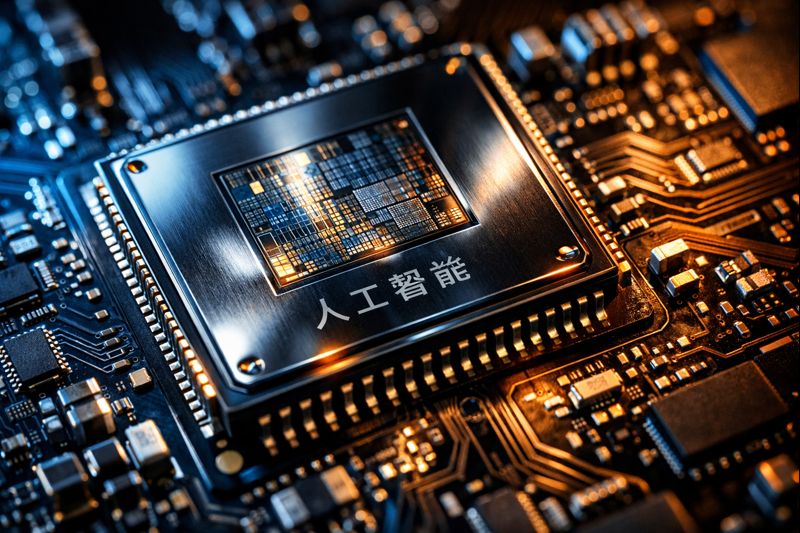
When the United States Bureau of Industry and Security enacted sweeping semiconductor export controls in October 2022, the conventional wisdom held that China’s artificial intelligence ambitions would be strangled in their infancy. Three years on, that prediction looks increasingly premature. Rather than capitulating to technological containment, China has constructed what analysts now describe as a “parallel AI chip universe”—a comprehensive ecosystem of domestic processors, software frameworks, and deployment architectures that challenges long-held assumptions about technological dependence and innovation velocity.
The implications extend far beyond Beijing’s borders. China’s semiconductor industry now produces chips that, whilst not matching the raw performance of Nvidia’s flagship offerings, achieve sufficient capability to power frontier AI models. More strikingly, Chinese firms have demonstrated that algorithmic ingenuity can compensate for hardware limitations—a paradigm shift exemplified by DeepSeek-V3.2-Speciale, which matches Google’s Gemini 3 Pro in reasoning benchmarks without relying on American semiconductors. This achievement raises uncomfortable questions for Western policymakers: can export controls truly constrain AI development when software optimisation and architectural innovation can bridge substantial hardware gaps?
The Chipmakers: From Garage Startups to Strategic Assets
China’s domestic AI chip sector represents one of the most consequential industrial mobilisations of the modern era. State investment exceeds $150 billion—roughly triple the funding allocated under America’s CHIPS and Science Act—creating a gravitational force that has pulled thousands of engineers, many with experience at Nvidia, AMD, and Qualcomm, into Chinese startups. The result is a diverse ecosystem ranging from nimble ventures to telecommunications giants pivoting towards silicon.
Huawei dominates this landscape through its HiSilicon division, whose Ascend series processors have emerged as China’s primary alternative to Nvidia’s data centre GPUs. The Ascend 910C, fabricated using Semiconductor Manufacturing International Corporation’s (SMIC) 7-nanometre process, integrates approximately 53 billion transistors and delivers around 320 TFLOPS of FP16 performance. Research from DeepSeek indicates the chip achieves roughly 60 per cent of Nvidia’s H100 inference performance—a figure that, whilst substantial, underscores the persistent performance delta between Chinese and American semiconductors.
Yet raw performance metrics obscure more nuanced developments. Huawei is shipping an estimated 1.2 million Ascend 910C dies throughout 2025, despite yields reportedly lower than Taiwan Semiconductor Manufacturing Company’s (TSMC) advanced nodes. The company’s three-year roadmap envisions next-generation Ascend 950 chips incorporating FP8 precision and a proprietary interconnect technology called “Lingqu,” designed to enable million-card scale clusters. This represents a strategic bet: rather than pursuing CUDA compatibility, Huawei has developed MindSpore, a parallel software framework optimised for distributed training and automatic parallelisation.
Beyond Huawei, a constellation of well-funded startups competes for market share. Cambricon Technologies, founded by two brothers from the University of Science and Technology of China’s prestigious youth programme, launched its 7-nanometre Siyuan 590 chip in 2024, modelled after Nvidia’s A100. The company reported revenue surging 43-fold to $404 million in the first half of 2025, driven primarily by a major order from ByteDance. Moore Threads, established by Nvidia’s former China general manager Zhang Jianzhong, claims its latest GPU cluster rivals foreign systems in efficiency despite massive losses—4.6 billion yuan between 2022 and 2024 against 3.8 billion in research and development spending.
Biren Technology and MetaX Integrated Circuits complete the picture, both racing towards initial public offerings on Shanghai’s STAR Market. MetaX’s forthcoming C600 chip, developed using domestic supply chains and targeting mass production in early 2026, exemplifies the sector’s evolution from importing foreign intellectual property to developing indigenous architectures. These firms remain unprofitable—MetaX accumulated losses of 2.72 billion yuan from 2022 to 2024—but investor enthusiasm reflects confidence in eventual market dominance within China’s protected domestic ecosystem.
The H200 Benchmark: Measuring the Gap
To contextualise Chinese achievements, one must understand what they’re attempting to replicate. Nvidia’s H200 Tensor Core GPU, built on the Hopper architecture, represents the apotheosis of contemporary AI acceleration technology. It features 141 gigabytes of HBM3e memory operating at 4.8 terabytes per second—nearly double the H100’s capacity with 40 per cent greater memory bandwidth. For large language model inference, these specifications translate to approximately 1.9 times the throughput of the H100 on Llama2-13B models, and up to 3.4 times performance improvement for long-context processing workloads.
The H200’s architecture addresses the “memory wall” problem that constrains frontier AI applications. Its expanded memory capacity enables processing of 100-plus-billion-parameter models in 16-bit precision, whilst the enhanced bandwidth accelerates the token generation bottleneck that dominates inference latency. Preliminary benchmarks indicate the H200 achieves roughly 11,819 tokens per second on Llama2-13B, compared to approximately 6,200 for the H100. For Llama2-70B, the performance advantage reaches similar magnitudes—around 3,014 tokens per second versus 1,600 for its predecessor.
Chinese chips cannot match these specifications. The Ascend 910C’s 128 gigabytes of HBM3 memory exceeds the H100’s 80 gigabytes, yet its bandwidth and compute throughput lag substantially. More critically, manufacturing constraints limit production volumes and drive down yields, whilst SMIC’s 7-nanometre process consumes more power per operation than TSMC’s advanced nodes. The performance-per-watt equation remains decisively in Nvidia’s favour.
However, this straightforward comparison obscures China’s actual strategy. Rather than achieving parity chip-for-chip, Chinese firms deploy architectural solutions that leverage superior scale. Huawei’s CloudMatrix 384 system interconnects 384 Ascend 910C chips in an all-optical mesh network, achieving approximately 300 petaFLOPS of BF16 performance—roughly double Nvidia’s GB200 NVL72 system’s 150 petaFLOPS. Memory capacity reaches 49.2 terabytes, about 3.6 times the GB200’s allocation. The trade-off manifests in power consumption: CloudMatrix 384 requires 3.9 times more energy than Nvidia’s solution, a challenge mitigated by China’s abundant electricity generation—10,000 terawatt-hours in 2024, over double American output—and subsidised energy prices.
The DeepSeek Revelation: Software Trumps Hardware
If China’s chip production capabilities remain constrained, its software engineering prowess offers a compensatory advantage that Western observers have consistently underestimated. DeepSeek-V3.2-Speciale, released in December 2025, achieved gold-medal performance on the International Mathematical Olympiad—a milestone previously reached only by proprietary models from OpenAI and Google DeepMind. Internal benchmarks indicate it matches or exceeds Google’s Gemini 3 Pro on reasoning tasks, achieving 96.0 on AIME 2025 compared to Gemini’s 95.0, whilst training costs reportedly totalled just $5.6 million using approximately 2,000 Nvidia H800 GPUs.
The technical foundations merit examination. DeepSeek’s architecture employs Mixture-of-Experts (MoE) design, activating only 37 billion parameters per token from a total 671-billion-parameter model. This sparse activation pattern dramatically reduces computational requirements during inference, enabling competitive performance despite hardware limitations. The model incorporates “DeepSeek Sparse Attention,” a mechanism that addresses the efficiency bottleneck of long-context processing by selectively attending to relevant tokens rather than processing entire sequences uniformly.
Critically, DeepSeek demonstrates native compatibility with Huawei’s Ascend processors through optimised CANN (Compute Architecture for Neural Networks) kernels. The company maintains its own PyTorch repository, facilitating single-line conversions from CUDA to CANN and enabling seamless hardware portability. This vertical integration—from chip architecture through framework support to model deployment—mirrors Nvidia’s historically unassailable advantage whilst operating entirely within China’s technology stack.
The implications transcend specific benchmark results. DeepSeek proves that frontier AI capabilities need not depend on accessing the absolute cutting edge of semiconductor manufacturing. By optimising algorithms for available hardware, Chinese researchers have decoupled model performance from process node advancement—a form of technological jujitsu that transforms supposed weaknesses into strategic advantages. If a $5.6 million training run produces results comparable to models costing orders of magnitude more, the economic calculus of AI development shifts fundamentally.
Strategic Implications: Decoupling Accelerates
The trajectory of China’s AI chip industry challenges three core assumptions that underpinned Western technology policy. First, that semiconductor export controls would create durable advantages by denying China access to advanced manufacturing capabilities. Second, that software ecosystems exhibit insurmountable lock-in effects, making alternatives to CUDA economically unviable. Third, that raw computational power constitutes the primary determinant of AI capability.
Each assumption now appears questionable. SMIC’s 7-nanometre production, whilst less efficient than TSMC’s processes, suffices for current AI workloads. Huawei shipped an estimated 1 million Ascend chips throughout 2025 despite American sanctions, capturing significant market share from Nvidia—whose China revenue declined from 21 per cent of total sales in October 2023 to 12 per cent in October 2024. Meanwhile, China’s AI patent filings quadrupled America’s by 2024, indicating sustained research momentum across both hardware and software domains.
The software ecosystem challenge deserves particular scrutiny. Nvidia’s CUDA platform represents two decades of cumulative development, creating switching costs that have deterred serious competition in Western markets. China’s “parallel ecosystem” strategy sidesteps this barrier through market segmentation. Within China’s protected domestic market, developers learn MindSpore through necessity rather than preference, building skills and institutional knowledge that increasingly enable indigenous innovation. The trade-off—sacrificing international portability for domestic optimisation—becomes acceptable when market scale reaches Chinese proportions.
Nvidia CEO Jensen Huang acknowledged this reality in October 2025, stating the United States is “not far ahead” of China in artificial intelligence competition. His assessment reflects commercial calculation as much as technical judgement: Nvidia now assumes zero China revenue in forecasts, having lost access to a market that previously represented 20 to 25 per cent of data centre sales. For semiconductor firms, China’s emergence as both customer-lost and competitor-gained constitutes a strategic inflection point whose full implications remain uncertain.
Looking ahead, several factors will determine whether China’s chip industry achieves genuine competitiveness or remains perpetually behind the technology frontier. High-bandwidth memory (HBM) supply represents a critical constraint. Huawei’s stockpile of approximately 11.7 million HBM units—including 7 million shipped by Samsung before export restrictions—will deplete by late 2025, potentially constraining Ascend 910C production. China’s primary domestic DRAM supplier, CXMT, projects output of merely 2.2 million HBM stacks in 2026, supporting only 250,000 to 400,000 packaged processors—well below Huawei’s requirements.
Manufacturing equipment poses equally formidable challenges. Even with ASML’s DUV lithography systems, producing competitive yields at 7-nanometre nodes requires mastering techniques like self-aligned quadruple patterning whilst operating under technology embargo. Huawei has reportedly initiated efforts to construct its own fabrication facilities and develop indigenous manufacturing equipment, but replicating entire supply chains demands capabilities that may exceed even Chinese industrial policy’s formidable reach.
Yet dismissing China’s progress as incremental would constitute strategic miscalculation. The 2022 export controls, intended to constrain, instead catalysed. Investment accelerated, talent mobilised, and the imperative for self-sufficiency transformed from aspiration into industrial strategy. Whether this trajectory produces genuine technology leadership or merely competent self-reliance remains uncertain. What seems beyond dispute is that America’s semiconductor dominance—long assumed permanent—now faces its most serious challenge since the industry’s inception. The parallel AI chip universe is no longer theoretical. It is operational, expanding, and competing.