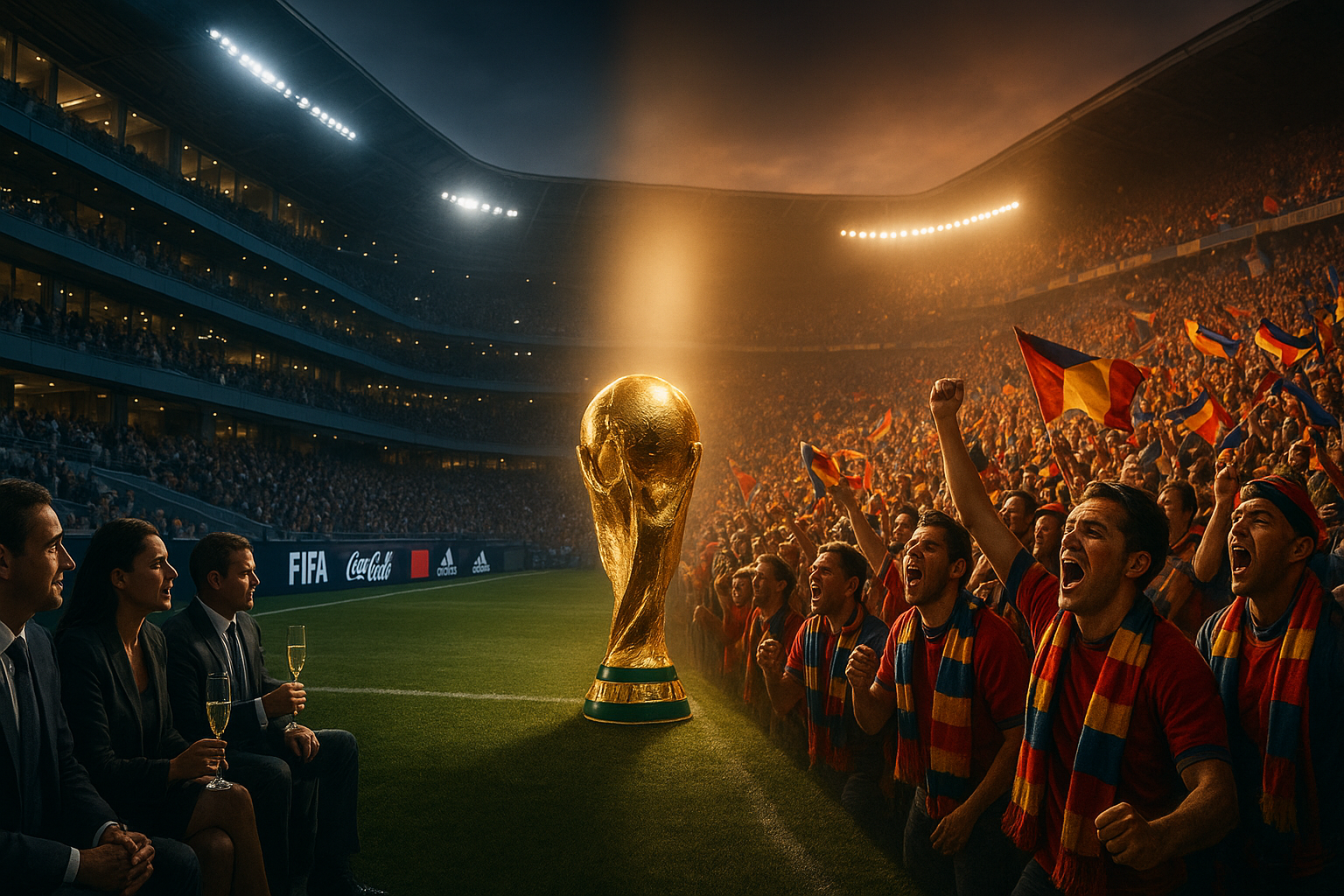
When FIFA opens the doors to its expanded 48-team World Cup across North America in June 2026, the organisation will unveil not merely a football tournament but a commercial experiment of unprecedented scale. With projections suggesting a US$40.9 billion GDP impact and five million ticket requests flooding in within 24 hours—despite widespread outrage over pricing—the event encapsulates modern football’s fundamental tension: can a sport rooted in working-class culture survive its transformation into a luxury product?
The numbers tell one story. The human cost may tell quite another.
A Tournament Reimagined for the Corporate Age
The 2026 FIFA World Cup represents a structural departure from tradition that extends far beyond geography. For the first time, three nations—the United States, Canada, and Mexico—will jointly host the tournament, spreading 104 matches across 16 cities and 39 days between 11 June and 19 July. The expansion from 32 to 48 teams introduces a new Round of 32 knockout stage and guarantees representation from all six continental confederations, a historic achievement that FIFA touts as football’s ultimate democratisation.
Yet this geographical sprawl presents immediate challenges. Supporters following their nations from group stage to final could traverse distances equivalent to crossing Europe multiple times. Teams face logistical complexities that dwarf previous tournaments, with travel between venues in Mexico City and Vancouver exceeding 4,000 kilometres. The decision to schedule the final at 3pm Eastern Time—8pm in Britain—reveals whose interests truly matter: European television markets, where advertising revenues reach their zenith during prime-time viewing hours.
The tournament’s infrastructure underscores its ambitions. Host cities boast stadiums averaging 68,500 seats, with venues like MetLife Stadium in New Jersey capable of accommodating over 82,000 spectators. These cavernous arenas, designed for American football and built with corporate hospitality suites embedded into their architecture, signal a tournament conceived for scale rather than intimacy. The atmospheric cauldrons of traditional European grounds—where supporters stand metres from the pitch—feel worlds away from these vast, climate-controlled amphitheatres where premium seating sections resemble luxury hotel lounges more than football terraces.
The Economics of Aspiration
FIFA and its partners project staggering economic returns. A comprehensive study conducted with the World Tourism Organization forecasts that the tournament will generate US$40.9 billion in GDP impact, create 824,000 full-time equivalent jobs, and deliver US$8.28 billion in social benefits. Individual host cities have commissioned their own analyses, each more optimistic than the last. Los Angeles anticipates US$594 million in economic activity. Kansas City expects US$653 million and 650,000 visitors. Seattle projects a minimum US$929 million boost for King County alone.
Hotel markets stand to benefit considerably, with revenue increases between 7 and 25 per cent forecast for June 2026 across host regions. New York and New Jersey expect the largest performance surges, given their proximity to the final and their established infrastructure for absorbing international visitors. Tourism Economics estimates that 1.24 million international visitors will travel to the United States specifically for the tournament, with 742,000 representing incremental arrivals who would not have visited otherwise. Long-term projections suggest an 8 to 12 per cent increase in tourism to host cities over the subsequent three years, as the World Cup serves as a global advertisement for North American destinations.
FIFA itself expects revenues between US$4.5 billion and US$5 billion from the tournament, contributing to a projected US$11 billion for the 2023-2026 commercial cycle—a US$4.56 billion increase over the previous four-year period. Broadcasting rights, sponsorship packages, and hospitality sales form the revenue triumvirate, with corporations willing to spend extraordinary sums for association with football’s premier event.
Yet these projections warrant scrutiny. Mega-event economic impact studies possess a notorious record of optimism bias, frequently overestimating benefits whilst underplaying costs. Infrastructure spending, much of it subsidised through public funds, rarely generates returns commensurate with initial investments. Stadium upgrades and transportation improvements benefit private entities—teams, broadcasters, FIFA—whilst taxpayers shoulder substantial portions of the bill. The 1994 World Cup in the United States, often cited as a commercial triumph, left mixed legacies in host cities where promised football infrastructure development failed to materialise as envisioned.
Furthermore, the distribution of economic benefits raises uncomfortable questions. Hotel chains, airlines, and multinational sponsors capture the lion’s share of revenue, whilst local businesses—particularly those outside immediate stadium precincts—see marginal gains. Service workers hired for the tournament typically receive temporary contracts with modest wages, hardly the transformative employment opportunities suggested by job creation figures. The question persists: who truly prospers from these spectacles?
The Pricing Out of the People’s Game
Nothing crystallises football’s identity crisis quite like the 2026 ticketing debacle. When FIFA announced pricing structures, the backlash proved immediate and fierce. Group stage matches will cost between US$180 and US$700 when purchased through national associations, with premium categories commanding significantly higher fees. Final tickets begin at US$4,185 for standard seating, climbing to US$8,680 for premium experiences. England supporters calculating the cost of following their team from opening match through to a potential final appearance face bills exceeding £5,228—approximately US$7,020.
These figures represent a roughly 500 per cent increase over Qatar 2022 pricing and a complete abandonment of promises made during the original 2018 bid, when organisers suggested tickets could be available for as little as US$21. That price point has vanished entirely from the official structure. FIFA has implemented dynamic pricing for the first time at a World Cup, allowing costs to fluctuate based on demand—a practice borrowed from airline booking systems and concert ticketing but entirely alien to football’s traditional fixed-price model.
Football Supporters Europe described the pricing as a “monumental betrayal” of the sport’s foundational communities. The organisation argues, compellingly, that tournaments designed to celebrate football’s global reach should not exclude the very supporters who sustain clubs week in and week out. Atmosphere at World Cups depends upon passionate, knowledgeable supporters who sing, chant, and create the spectacle that makes football culturally significant. Corporate guests occupying premium seats rarely generate such energy, often viewing matches as networking opportunities rather than sporting theatre.
The 5 million ticket requests received within the first 24 hours, despite widespread criticism, suggest that FIFA has successfully calculated demand elasticity. Enough affluent supporters and corporate buyers exist globally to fill stadiums at these prices, rendering traditional supporters economically irrelevant to the event’s financial model. This represents a philosophical shift: the World Cup transitions from a tournament accessible to ordinary people into a luxury experience for the global elite. One wonders what atmosphere will prevail when stadiums fill with spectators who can afford £700 tickets but possess limited understanding of football culture beyond Instagram moments and halftime champagne.
Sporting Drama Amidst Commercial Calculation
The expanded format generates fascinating sporting narratives, even as critics question whether diluting the field from 32 to 48 teams diminishes competitive quality. Group L emerges as an early “Group of Death,” featuring England, Croatia, Ghana, and Panama—a quartet combining European pedigree with African unpredictability and Central American determination. Group K offers intrigue through Portugal’s likely inclusion of a 40-year-old Cristiano Ronaldo, Colombia’s dependence on 35-year-old James Rodríguez’s fitness, and Uzbekistan’s World Cup debut.
For purists, the tournament’s most poignant subplot involves Lionel Messi and Ronaldo, arguably appearing at their final World Cups at ages 38 and 40 respectively. These icons have defined two decades of football, their rivalry elevating the sport’s global profile immeasurably. Their presence in North America guarantees attention from casual observers worldwide, precisely the audience FIFA covets for maximising commercial returns.
The United States men’s national team inherits a relatively favourable Group D draw, facing Paraguay, Australia, and a European playoff winner yet to be determined. Brazil, perennial favourites, anchor Group C alongside Morocco, the 2022 semifinalists who captured imaginations with their historic run in Qatar. France versus Norway presents an opportunity to witness Kylian Mbappé confronting Erling Haaland, two generational talents whose club rivalry now extends to the international stage.
Yet the format’s expansion threatens to undermine competitive intensity. With 32 of 48 teams progressing to knockout rounds, the group stage risks becoming a procession rather than a crucible. Mediocre teams will advance, potentially creating mismatches in the Round of 32 that diminish rather than enhance drama. FIFA counters that increased participation allows more nations to experience football’s pinnacle, cultivating the sport in emerging markets. Critics respond that diluting quality serves commercial expansion rather than sporting excellence.
Legacy, Legitimacy, and the Long Game
The 2026 World Cup unfolds against a backdrop of broader questions about mega-events in contemporary society. Environmental concerns regarding a tri-nation format cannot be dismissed lightly; the carbon footprint of teams, supporters, and media crisscrossing North America by air contradicts FIFA’s sustainability pledges. The organisation promotes green initiatives and carbon offset programmes, yet these measures feel performative when set against the fundamental environmental costs of such geographical dispersion.
There exists, too, a soft power dimension. The United States, hosting its first World Cup in 32 years, seeks to demonstrate organisational competence and cultural sophistication on a global stage. The tournament arrives two years before Los Angeles hosts the 2028 Olympics, creating a sequence of mega-events designed to reinforce American relevance in international sport. Whether American audiences embrace football with lasting enthusiasm remains uncertain—previous efforts to establish the sport domestically have achieved mixed results, with Major League Soccer occupying a tertiary position behind American football, basketball, and baseball.
Host cities gamble that infrastructure investments will yield long-term benefits: improved transportation networks, enhanced global profiles, sustained tourism growth. History suggests caution. Olympic hosts routinely face decades of debt servicing for facilities that fall into disuse. World Cup hosts fare somewhat better, given that football stadiums possess ongoing utility, yet the promised transformations rarely materialise as envisioned. Will Kansas City genuinely experience sustained economic elevation, or will the tournament represent a brief spike followed by return to baseline? Will Seattle’s upgraded transit systems justify their costs through increased daily usage, or will they stand as expensive monuments to a three-week spectacle?
The Soul of the Game Hangs in the Balance
The 2026 World Cup forces a reckoning with football’s trajectory. The tournament will undoubtedly succeed commercially—stadiums will fill, television audiences will shatter records, revenues will meet or exceed projections. FIFA will proclaim vindication, pointing to record participation, unprecedented scale, and billions in economic activity as evidence of visionary leadership.
Yet commercial success and cultural authenticity need not align. If ordinary supporters cannot afford tickets, if corporate hospitality replaces passionate atmospheres, if the tournament becomes indistinguishable from any other luxury entertainment product, what remains of football’s unique character? The sport’s power has always derived from its accessibility, its capacity to unite communities across class boundaries, its rootedness in local identity whilst simultaneously offering global spectacle.
The expansion to 48 teams, the pricing strategies that favour corporate buyers, the geographical sprawl that prioritises television markets over supporter experience—these decisions reveal a governing body that has chosen maximising revenue over preserving tradition. Whether football’s essence survives this transformation depends upon forces beyond FIFA’s control: whether supporters continue caring about tournaments that exclude them, whether new audiences in North America embrace the sport with genuine passion rather than casual curiosity, whether the chase for ever-larger revenues eventually alienates the communities that made football culturally significant in the first place.
Come June 2026, the world will watch. The question is whether they’ll recognise the game they once loved.