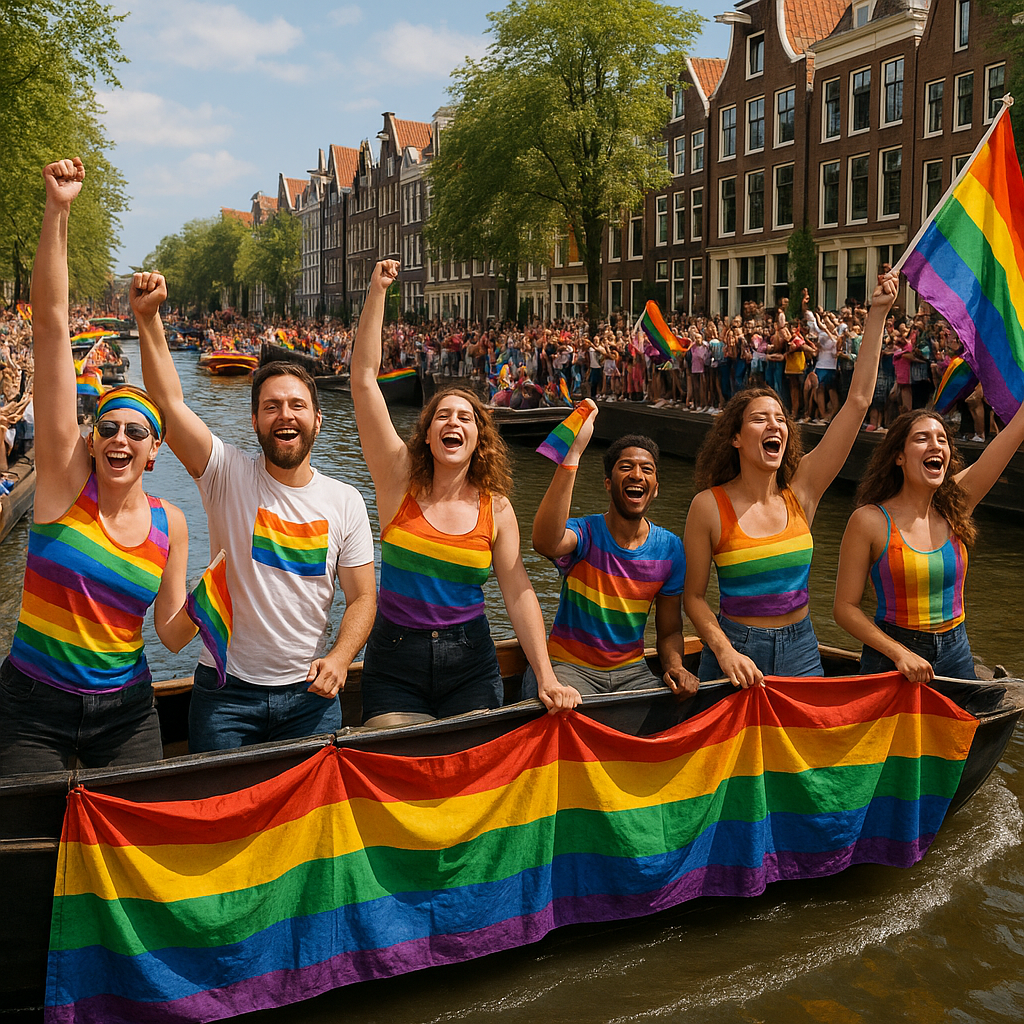
On a crisp Saturday morning in August, Amsterdam transforms into something magnificent. The city’s 17th-century canals, normally graced by tourist boats and dignified houseboats, become the stage for one of Europe’s most spectacular celebrations of love, equality, and unapologetic joy. The Amsterdam Canal Parade, the crowning jewel of Pride Amsterdam, draws half a million spectators to witness 80 decorated boats sailing through UNESCO-listed waterways in a riot of colour, music, and defiant celebration.
This aquatic spectacle, scheduled for August 2nd, 2025, represents far more than a single day’s festivities. It embodies the Netherlands’ remarkable journey from a nation where homosexuality was criminalised until 1811 to becoming what many consider the world’s most LGBTQ+-friendly country. The Dutch didn’t simply arrive at tolerance; they architected acceptance with the methodical precision that built their iconic canal systems.
The Architecture of Acceptance
The Netherlands’ reputation as a sanctuary for sexual and gender minorities isn’t accidental marketing—it’s the result of deliberate cultural engineering spanning decades. The numbers tell a compelling story: 93% of Dutch people believe homosexuals should live their lives as they wish, with just 4% believing that homosexuality should be rejected. These aren’t merely progressive statistics; they represent a fundamental shift in how a society understands human dignity.
This transformation becomes even more remarkable when placed in global context. In 2020, Iceland, Norway, the Netherlands, Sweden, and Canada were the most accepting countries according to the Williams Institute’s Global Acceptance Index. Yet the Netherlands stands apart, not just for its acceptance levels, but for how that acceptance manifests in spectacular public celebration.
The Canal Parade itself embodies this Dutch approach to Pride—practical yet magical, historic yet progressive. The boat parade will be held for the 28th time in 2025, making it a tradition that has evolved alongside the country’s changing attitudes. Unlike Pride events in other cities that march through streets, Amsterdam’s celebration floats through canals that have witnessed four centuries of history, creating a uniquely poetic marriage of heritage and hope.
Beyond Tolerance: The Economics of Equality
What sets the Dutch Pride experience apart is how seamlessly it integrates into the fabric of national identity. Pride Amsterdam Canal Parade: 2nd most popular event (after King’s Day), a positioning that speaks volumes about how LGBTQ+ celebration has moved from the margins to the mainstream. This isn’t tolerance as condescension; it’s celebration as cultural cornerstone.
The festival’s success reflects broader societal attitudes that go beyond mere legal protections. While the Netherlands became the first country to legalise same-sex marriage in 2001, the real achievement lies in how LGBTQ+ rights became woven into the national consciousness. As of 2011 show support of homosexuality and oppose anti-gay attitudes in immigrant groups, stating that the country has a “Dutch tradition of tolerance” for homosexuality, demonstrating how mainstream political discourse has evolved.
This evolution carries significant economic implications. Amsterdam’s Pride events attract international visitors during what would otherwise be peak summer tourist season, generating substantial revenue while positioning the Netherlands as a global destination for LGBTQ+ travellers. The announcement that Amsterdam will host WorldPride 2026 represents both recognition of the city’s achievements and a massive economic opportunity, likely to draw hundreds of thousands of international visitors.
The Theatre of Visibility
The Canal Parade’s genius lies in its theatrical impossibility to ignore. It features over 80 boats decorated with bright themes, carrying strong messages of equality and joy. The boats sail through the UNESCO-listed 17th-century canal ring, creating a moving artwork that transforms the entire city centre into a stage. Spectators can’t simply change channels or scroll past—the celebration commands attention through sheer geography.
This visibility carries profound political weight. In an era when LGBTQ+ rights face renewed challenges globally, the Dutch approach offers a masterclass in normalisation through celebration. The parade doesn’t apologise for queerness; it celebrates it with such exuberant confidence that opposition seems not just wrong but deeply unfashionable.
The event’s scale speaks to its cultural significance. The world-famous Canal Parade will sail through Amsterdam’s canals on Saturday, 2 August 2025, from 12:00 to 18:00, dedicating an entire Saturday to LGBTQ+ celebration in the heart of one of Europe’s most visited cities. This temporal commitment—six hours of prime weekend time in the city centre—represents a civic investment that few societies would make for any minority community.
Challenges in the Promised Land
Yet the Netherlands’ LGBTQ+ paradise isn’t without its complexities. While only 7% of the Dutch viewed homosexuality and bisexuality negatively and 10% viewed transgender people negatively according to 2016 research, these statistics mask important nuances about acceptance across different communities and regions.
The reality of Dutch tolerance reveals itself as more sophisticated than simple blanket acceptance. Rural areas remain more conservative, and certain immigrant communities maintain attitudes that clash with mainstream Dutch values around sexuality and gender. This tension has become particularly visible in political discourse, where politicians across the spectrum now frame LGBTQ+ rights as core Dutch values that new immigrants must embrace.
The Amsterdam Pride experience, therefore, represents both achievement and aspiration. It showcases what’s possible when a society commits to celebration over mere tolerance, while acknowledging that even in the world’s most accepting countries, the work of building inclusive communities continues.
The Global Stage
As Amsterdam prepares to host WorldPride 2026, the Netherlands finds itself positioned as more than just a case study in LGBTQ+ acceptance—it’s become a template for how societies might evolve beyond tolerance toward celebration. The Canal Parade, with its unique blend of historical reverence and progressive values, offers a compelling vision of how tradition and transformation can coexist.
The Dutch approach suggests that Pride isn’t just about rights—it’s about joy, visibility, and the radical act of public celebration. In converting their historic canals into stages for LGBTQ+ celebration, the Netherlands demonstrates that acceptance isn’t simply about changing laws; it’s about reimagining what public space can become when societies choose celebration over fear.
As boats prepare to sail through Amsterdam’s canals in August 2025, they’ll carry more than rainbow flags and party-goers. They’ll bear witness to a society that chose to transform its historic waterways into channels of acceptance, proving that the most profound revolutions sometimes happen not through protest, but through the simple, radical act of floating downstream in full, glorious view of the world.
Share your thoughts by leaving a comment below and enjoy a few photos from the gay pride in Alkmaar on May 31st 2025: on Flickr