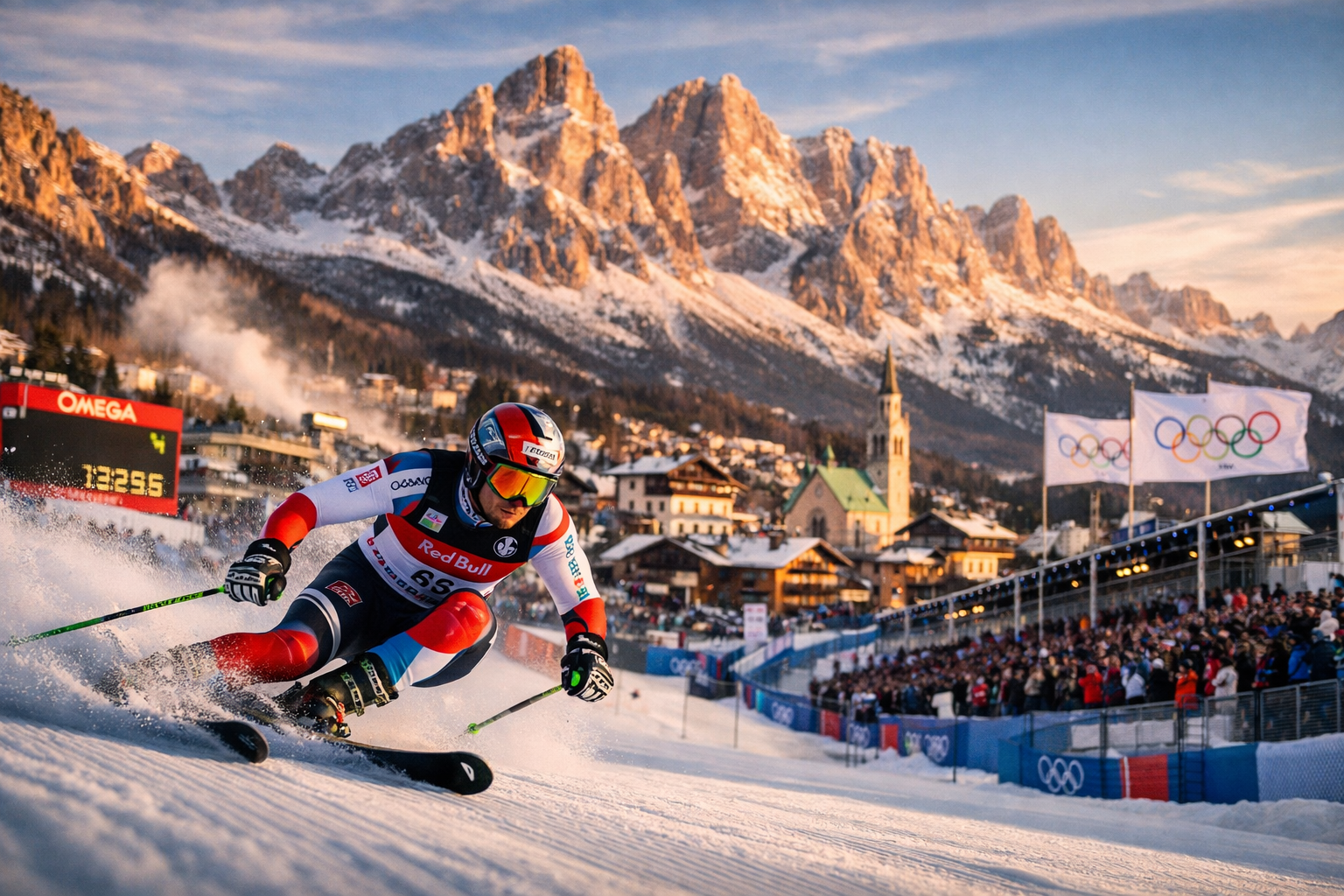
How Milan Cortina 2026 is redefining the economics, sustainability, and geopolitics of Winter Olympics
As the Olympic flame blazes at Milan’s Arco della Pace and alpine winds whip across Cortina’s Dolomites, the 2026 Winter Olympics are unfolding as something far more significant than a sporting spectacle. These Games represent a critical experiment in how the Olympic movement can evolve—or whether it can survive at all—in an era of climate crisis, geopolitical upheaval, and mounting scepticism about mega-events’ true value. With an estimated economic impact of €5.3 billion and the spectre of warming winters threatening winter sport’s very existence, Milan Cortina 2026 sits at the crossroads of sport, politics, and planetary survival.
A New Olympic Blueprint
Seventy years after Cortina d’Ampezzo first hosted the Winter Games in 1956, Italy has returned to the Olympic stage with a radically different approach. Unlike the concentrated, infrastructure-heavy models that bankrupted cities from Sochi to Athens, Milan Cortina has embraced dispersion. Events sprawl across five regions—Milan, Cortina, Verona, Valtellina, and Val di Fiemme—a geographical spread that initially drew criticism but now appears prescient.
The strategy reflects the International Olympic Committee’s ‘Olympic Agenda’ reforms, designed to reduce the financial burden that has deterred potential hosts. Of the 15 competition venues, 85 per cent are existing or temporary structures—one of the highest reuse rates in Winter Olympic history. Bormio’s legendary Stelvio slope, which has hosted World Cup races for decades, requires minimal modification. Val di Fiemme’s cross-country facilities and Anterselva’s biathlon centre are already world-class. Only two major new builds—the Cortina sliding centre and Milan’s Santa Giulia hockey arena—required construction from scratch, and both are designed for post-Olympic commercial use.
This pragmatism comes with a price tag, but one notably lower than recent predecessors. The operating budget now stands at approximately €1.7 billion, increased from €1.6 billion due to post-pandemic inflation. Yet this figure remains substantially below Beijing 2022’s estimated €4 billion and infinitesimally smaller than Sochi 2014’s staggering €51 billion. As Mariamena Ruggiero, an analyst at S&P Global Ratings, noted: ‘Milano-Cortina cost less than those in Sochi and Beijing but more than any other winter games held in the past 20 years.’
The €5.3 Billion Question
According to Banca Ifis, the total economic impact of Milan Cortina 2026 is projected to reach €5.3 billion. This breaks down into three distinct phases: €1.1 billion from immediate tourist and operational spending during the Games themselves, €1.2 billion from sustained tourism flows over the following 12-18 months, and €3 billion attributed to infrastructure and legacy investments.
Early indicators suggest these projections may prove conservative. Visa cardholders’ flight and accommodation data reveal a 160 per cent increase in international arrivals to northern Italy during the Games period. Domestic enthusiasm is equally robust, with nearly 80 per cent of residents in host regions expressing desire to attend at least one event. Hotels across Milan, Cortina, Verona, and Venice report surging occupancy rates, with average nightly rates reaching €1,752 in Cortina and €412 in Milan.
Yet the optimism requires context. Chloe Parkins, lead economist at Oxford Economics, cautions that whilst Italy is on course to welcome 66 million international tourists in 2026—up from 60 million in 2023—the Winter Olympics’ tourism impact inevitably pales beside summer equivalents. Paris 2024 sold between 10-12 million tickets; Milan Cortina expects approximately 2.5 million spectators. The Italian government has approved an additional €200 million for tourism promotion, logistics, and security, whilst municipalities within 30 kilometres of Olympic venues are authorised to raise tourist tax rates during 2026, with 50 per cent of proceeds allocated centrally.
The infrastructure legacy presents a more ambiguous picture. Enhanced accessibility, upgraded transport systems, and modernised medical facilities will undoubtedly serve communities beyond February 2026. The Porta Romana Olympic Village in Milan is slated to become student housing, whilst Santa Giulia arena will transition to commercial sports and events. Yet transparency concerns persist. Open Olympics 2026, a civic network led by Libera and including WWF Italy and Legambiente, reports that of the €3.54 billion spent by the Milan-Cortina Infrastructure Company (Simico), only 13 per cent concerns works directly linked to competitions. The remaining 87 per cent funds ‘legacy’ infrastructure—roads, railways, and facilities that may never be completed.
Winter Sport on Thin Ice
The warming climate casts a shadow over every Winter Olympics, but Milan Cortina confronts the crisis with particular urgency. In the 70 years since Cortina first hosted the Games in 1956, February temperatures in the Dolomite town have risen by 3.6°C. The number of freezing days has declined by 41 annually—a 19 per cent reduction. Climate Central research indicates that of 93 potential host sites worldwide, only 52 would have reliably suitable conditions for Winter Olympics by the 2050s.
Artificial snow has become not merely supplementary but essential. Milan Cortina requires more than 3 million cubic metres of manufactured snow—an operation that consumes vast quantities of water and energy whilst degrading soil quality. The paradox is stark: the solution designed to mitigate warming’s effects actively contributes to the problem it purports to solve. The Games’ anticipated greenhouse gas emissions total approximately 930,000 tonnes of CO₂ equivalent directly linked to organisation, according to the ‘Olympics Torched’ report by the New Weather Institute. An additional 1.3 million tonnes stem from sponsorship agreements with high-carbon companies. This combined impact is projected to result in the future loss of 5.5 square kilometres of snow—equivalent to more than 3,000 Olympic-size ice hockey rinks.
Organisers tout sustainability initiatives: 85 per cent venue reuse, renewable electricity powering almost all facilities, strategic environmental assessments across multiple regions. Gloria Zavatta, Sustainability and Impact Director for Fondazione Milano Cortina 2026, emphasises ‘practical measures that last throughout the Games, from venue reuse to circular economy solutions.’ Yet critics argue that sustainable Olympics remains an oxymoron. Environmental activists point to the Cortina bobsleigh track, which required felling over 20,000 square metres of forest, including approximately 500 centuries-old larches. The proposed Apollonio-Socrepes cable car project—marketed as sustainable infrastructure—lacks essential environmental impact assessments and carries serious avalanche risk.
The AIN Dilemma
Geopolitics infiltrates every Olympics, but Milan Cortina navigates particularly treacherous waters. Following Russia’s invasion of Ukraine in February 2022 and the Russian Olympic Committee’s subsequent suspension for breaching territorial integrity by incorporating Ukrainian regional sports organisations, Russian and Belarusian athletes compete under severely restricted conditions. They appear not as national teams but as Individual Neutral Athletes (AIN)—a designation introduced at Paris 2024 and continued here.
The numbers tell a story of diminished presence. At Beijing 2022, competing as the Russian Olympic Committee, Russian athletes claimed 32 medals including five golds. For Milan Cortina, only 13 Russian and seven Belarusian athletes gained AIN status after rigorous vetting by the Individual Neutral Athlete Eligibility Review Panel. Criteria are stringent: no voluntary links with military or security agencies, no public support for the war in Ukraine, full anti-doping compliance. They compete without flags, without anthems, and crucially, without participation in team events. No Russian ice hockey squad will challenge for gold; no team figure skating entries bear Cyrillic names.
The policy’s effectiveness remains contested. Sport geopolitics expert Lukas Aubin argues that excluding Russian athletes damages the Kremlin by removing a potent propaganda tool. Yet even as AINs, Russian performances serve domestic messaging. Any victory is reframed by state media as vindication against ‘unjust Western sanctions,’ with the neutral designation conveniently omitted. The participation itself—however limited—allows Russia to project a narrative of gradual return to normalcy, chipping away at restrictions through international fatigue. Latvia’s broadcasting approach exemplifies the controversy: both Latvian Public Media and TV3 Group announced they would halt live coverage whenever Russian or Belarusian athletes compete, switching to commercial breaks or alternative content—a partial boycott that sparked heated debate about press freedom versus political solidarity.
Stars, Comebacks, and Redemption
Amidst the macro narratives of economics and geopolitics, individual stories provide the Games’ emotional core. Mikaela Shiffrin arrives seeking redemption. The American alpine skier, with 108 World Cup victories to her name—more than any skier in history—endured disaster at Beijing 2022: did not finish in slalom, giant slalom, and combined; ninth in super-G; eighteenth in downhill. Now 30, she competes whilst navigating a November 2024 crash that required abdominal surgery. ‘I feel very aware of all the things that could happen that I can’t expect,’ she told TIME. ‘I know very well that we could do everything right on paper and it might not end up with a medal.’
Chloe Kim chases history. The American snowboarder, gold medallist in halfpipe at both PyeongChang 2018 and Beijing 2022, could become the first woman to secure three consecutive Olympic golds in the event—though she ultimately claimed silver after South Korea’s 17-year-old Gaon Choi’s stunning debut performance. Kim competed through shoulder injury, her participation itself a testament to determination. Her voice extended beyond sport when she called for unity after President Donald Trump criticised teammate Hunter Hess: ‘In moments like these, it is really important for us to unite and kind of stand up for one another.’
Lindsey Vonn’s presence defies conventional wisdom about athletic longevity. The 40-year-old downhill specialist, who last competed at PyeongChang 2018, emerged from retirement to compete in her fifth Winter Olympics. Meanwhile, Norway’s Johannes Høsflot Klæbo continued his dominance in cross-country skiing, winning gold in the skiathlon, sprint classic, and 10km events—adding to a collection that now rivals the sport’s all-time greats. Switzerland’s Franjo von Allmen secured his third gold medal of these Games in men’s super-G, whilst American figure skating phenomenon Ilia Malinin—the ‘Quad God’—suffered a shocking collapse in his free skate, falling from near-certain gold to eighth place in one of the Games’ most stunning reversals.
The Verdict Awaits
As the Games progress towards their 22 February conclusion, Milan Cortina 2026 will be judged on multiple metrics: financial sustainability, environmental responsibility, geopolitical navigation, and sporting excellence. Early returns suggest a mixed verdict. The dispersed model appears to alleviate the white elephant syndrome that plagued predecessors, yet transparency concerns and cost overruns persist. Sustainability claims face credible challenges from environmental organisations documenting ecological damage. The AIN framework manages geopolitical tensions without entirely resolving them.
What remains undeniable is that these Games unfold at a pivotal moment. The 2030 Winter Olympics will return to the French Alps, where organisers are already scrutinising Milan Cortina’s choices with acute awareness of mounting climate challenges. The fundamental question persists: can Winter Olympics continue in a warming world, or are we witnessing the slow extinction of a sporting tradition born in an era of reliable snow and stable winters?
The Alpine gamble proceeds. The stakes—economic, environmental, geopolitical—have never been higher. Whether Milan Cortina 2026 represents sustainable evolution or elegant farewell will only become clear in the years ahead, when infrastructure either thrives or crumbles, when legacy projects either deliver or dissolve, and when winter sport either adapts or succumbs to the warming world that threatens its very existence. For now, the flame burns at the Arco della Pace, athletes chase their dreams across snow both natural and manufactured, and billions worldwide watch a spectacle that may—or may not—have a future.