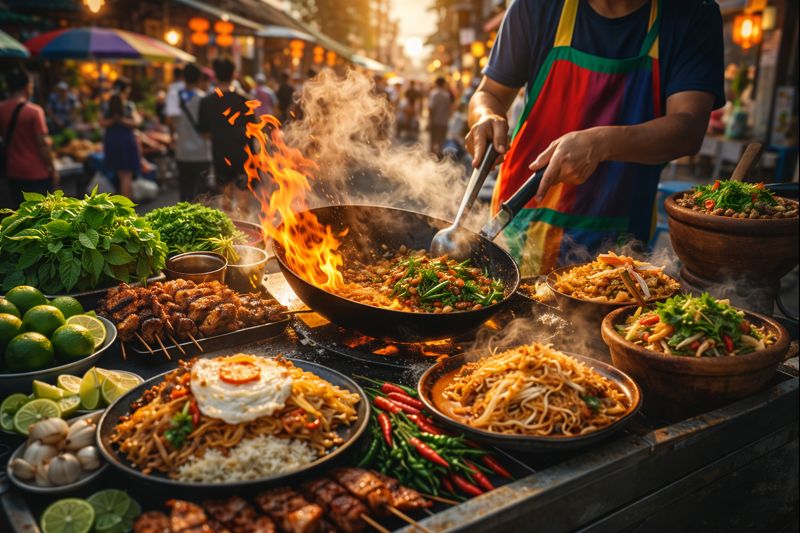
At precisely 6:47 on a Tuesday evening in Bangkok’s Chinatown, the air transforms into something edible. Charcoal smoke braids with caramelising palm sugar, fish sauce hisses against scorching wok metal, and somewhere between the tangle of electrical wires and fluorescent shop signs, a grandmother in a faded floral apron executes a wrist flick that sends ribbon noodles airborne. This is Jay Fai’s corner—literally, she owns this intersection—where a 76-year-old woman wearing ski goggles against oil splatter has earned a Michelin star whilst refusing to abandon her plastic stools and pavement location. Welcome to Thai street food, where culinary democracy meets edible philosophy, and where the most profound flavours often emerge from the humblest circumstances.
Thai street food isn’t merely a category of cuisine; it’s an economic system, a social infrastructure, and increasingly, a point of tension in rapidly modernising Asian cities. With an estimated 400,000 street vendors operating across Thailand—roughly 20,000 in Bangkok alone—generating approximately £3.2 billion annually, street food represents more than convenient sustenance. It’s how cities breathe, how communities form, and how culinary traditions adapt to modernity without entirely surrendering to it.
The Architecture of the Street
Thai street food culture emerged from practical necessity meeting geographical opportunity. Thailand’s tropical climate makes outdoor cooking not just feasible but preferable—heat dissipates naturally, and abundant fresh ingredients spoil quickly, favouring daily procurement over refrigerated storage. The traditional Thai household, particularly in urban areas, often lacks full kitchen facilities, making street vendors essential infrastructure rather than optional convenience.
As Thailand industrialised through the latter half of the twentieth century, rural workers flooded into Bangkok seeking employment. These migrants brought regional recipes—Isaan’s fiery som tam, the North’s rich khao soi, the South’s turmeric-stained Muslim curries—and adapted them for street-cart preparation. What emerged was a decentralised culinary archive, where individual vendors became living repositories of regional knowledge, their carts functioning as mobile restaurants specialising in sometimes just one or two dishes perfected over decades.
This specialisation creates an ecosystem of interdependence. Morning belongs to jok (rice porridge) vendors and khanom krok (coconut pancake) specialists. Lunch rushes demand efficiency: khao rad gaeng (curry over rice) stalls where customers point at pre-prepared dishes, or lightning-fast pad krapow operations where holy basil-scented pork hits the plate within ninety seconds. Evening activates the grilled protein merchants—moo ping skewers glistening with marinade of fish sauce, palm sugar, and coriander root—and dessert carts laden with mango sticky rice that achieves the paradox of being simultaneously heavy and refreshing.
The Greatest Hits: Democracy in Edible Form
Pad Thai occupies peculiar cultural real estate—simultaneously the dish most associated with Thailand globally and the one most scorned by purists as tourist fare. Yet dismissing pad Thai misses the point entirely. This tamarind-kissed tangle of rice noodles, dried shrimp, tofu, and egg represents Thai culinary philosophy in miniature: the interplay of sweet, sour, salty, and umami; the textural dialogue between soft noodles and crunchy peanuts; the option to customise heat levels with provided chilli flakes. A skilled vendor orchestrates all this in under three minutes, working a blazing wok with balletic efficiency. The dish costs approximately 40-60 baht (roughly £1), making it accessible whilst providing viable margins.
Som tam—green papaya salad—tells a different story. Originating in Isaan, Thailand’s northeastern region, som tam arrived in Bangkok through migrant labour. The dish embodies agricultural ingenuity: unripe papaya, too hard for direct consumption, gets julienned and pounded with lime, palm sugar, fish sauce, garlic, chillies, and often dried shrimp or fermented crab. The pounding isn’t mere technique; it’s transformation, breaking down the papaya’s cellular structure whilst bruising the garlic and chillies to release their oils. Street vendors prepare som tam to order in heavy clay mortars, the rhythmic thud of the pestle serving as acoustic advertisement.
Khao soi represents Northern Thai cuisine’s arrival on the national stage. This Chiang Mai speciality—a coconut curry broth enriched with both boiled and fried egg noodles, typically featuring chicken or beef—shows clear Burmese influence through its use of turmeric and dried spices rather than fresh curry paste. The dish arrives as theatre: a bowl of amber broth crowned with crispy noodle nests, accompanied by condiment plates of pickled mustard greens, shallots, lime wedges, and chilli oil. Each diner customises their bowl, creating individual flavour profiles from communal components.
Pad krapow deserves particular attention as possibly Thailand’s most consumed street dish—the automatic order when decision paralysis strikes. Minced pork (or chicken, or seafood) flash-fried with holy basil, fish sauce, oyster sauce, garlic, and chillies, served over rice with a fried egg, embodies working-class Thai cuisine at its most elemental. The dish requires high heat—the ‘wok hei’ that Chinese cooking celebrates—to properly char the basil without wilting it. Skilled vendors maintain their woks at temperatures approaching 300°C, the oil smoking violently as ingredients hit the metal. The entire cooking process takes perhaps two minutes, yet achieving the proper balance between caramelisation and scorching requires years of calibration.
The Michelin Effect and Its Discontents
When the Michelin Guide announced its first Bangkok edition in 2017, seventeen street food stalls received Bib Gourmand recognition—the guide’s designation for excellent food at moderate prices. Jay Fai received an actual star, becoming perhaps the world’s most celebrated street food vendor. The global media response was rapturous: here was validation that ‘cheap eats’ could achieve culinary excellence, that expertise dwells everywhere, that formality isn’t prerequisite for greatness.
The local response proved more complicated. Jay Fai’s prices quintupled almost overnight; queues became hours-long ordeals dominated by international tourists wielding Instagram accounts. Regular customers found themselves priced out of establishments they’d patronised for decades. The Michelin recognition, whilst technically celebrating accessibility, paradoxically destroyed it. Similar patterns emerged across recognised stalls—acclaim transformed affordable food into aspirational dining experiences.
This tension illuminates broader questions about street food’s future. Bangkok’s government has oscillated between embracing street vendors as cultural assets and attempting to clear them entirely in the name of modernisation and traffic flow. In 2017, officials announced plans to ban street food from major roads, triggering massive public backlash. The policy reversed within months, but the impulse persists.
The Economics of the Cart
Street food vendors operate within remarkably tight margins. A successful cart might generate 2,000-3,000 baht daily (£45-70), but ingredients, fuel, cart rental, and unofficial ‘fees’ to local authorities consume much of this. Yet the system persists because it provides entry points to entrepreneurship requiring minimal capital investment—roughly 50,000 baht (£1,150) can establish a basic operation. For comparison, opening a conventional restaurant in Bangkok requires investment starting around 2 million baht (£46,000).
The affordability extends to consumers. Thailand’s minimum wage hovers around 330 baht daily (£7.60); a substantial street meal costs 40-60 baht. This means workers can eat well on roughly 15-20% of daily earnings—a ratio that makes street food not luxury but necessity. Food tourism statistics reveal the appeal: approximately 42% of international visitors to Thailand cite cuisine as a primary motivation, with street food specifically attracting food-focused travellers who spend on average 28% more per day than general tourists.
Geography on a Plate
Thai street food’s diversity directly maps onto the country’s geography and cultural zones. Southern Thailand’s Muslim-majority provinces produce streets lined with roti vendors, their griddles working paper-thin dough into crispy, ghee-soaked flatbreads served with intensely spiced curries featuring turmeric and galangal. Phuket’s morning markets offer khao yam, a rice salad that assembles herbs, vegetables, and dried fish into flavour combinations that shouldn’t work but absolutely do.
Isaan street food—Bangkok’s most common regional variant due to historical migration patterns—tends towards bold, assertive flavours: larb (minced meat salad), sai krok (sour fermented sausage), and the notorious pla ra (fermented fish sauce) that locals adore and newcomers find challenging. Northern cuisine offers gentler, more aromatic dishes: sai oua (Northern sausage fragrant with lemongrass and kaffir lime), kanom jeen nam ngiao (fermented noodles with tomato-based curry), and the aforementioned khao soi.
Smoke Signals from the Future
Thai street food faces an uncertain trajectory. Climate change threatens ingredient availability and makes outdoor cooking increasingly brutal for vendors who already work in extreme heat. Generational succession poses challenges—younger Thais increasingly pursue education and office employment rather than inheriting family carts. Food safety regulations, whilst often necessary, sometimes impose requirements that informal vendors struggle to meet without pricing themselves beyond their customer base.
Yet resilience defines this tradition. Street food adapts constantly: electric woks supplementing charcoal, QR code payment systems appearing alongside cash, delivery apps creating new revenue streams. Some vendors have evolved into small restaurant chains whilst maintaining street-level pricing. Others double down on tradition, becoming destination stops for those seeking authentic preparation methods and time-honoured recipes.
What persists, regardless of format, is the fundamental democracy of excellent food. Thai street food refuses the notion that culinary sophistication requires white tablecloths or prix fixe menus. It insists that a woman working a wok on a plastic stool can achieve flavours that Michelin-starred chefs study and struggle to replicate. It maintains that eating well should be affordable, accessible, and woven into daily life rather than reserved for special occasions.
As that Chinatown grandmother flips another serving of crab omelette—her speciality for forty-seven years—the lesson becomes clear: sophistication isn’t about expense or formality. Sometimes it’s simply about understanding that the perfect balance of fish sauce, lime, sugar, and chilli, delivered at precisely the right temperature in exactly three minutes, represents a form of genius that no amount of formal training can manufacture. Thai street food doesn’t merely feed people; it argues, persuasively and deliciously, for a more democratic understanding of culinary excellence itself.